Gobble-gobble

In English we say Germany, not Deutschland. We say Italy, not Italia. We say Croatia, not Hrvatska. We say China, not Zhōngguó. And so on.

So why are so many news outlets and other organizations now saying Türkiye? (Or at least printing it—who knows how they say it.) What makes Turkey so special?

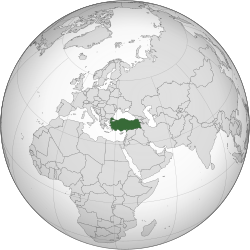
location of Turkey on the globe
Image by Emir at Wikimedia

This change has not yet become universal. Given that it is perfectly reasonable to keep calling that country Turkey, and that no ordinary English-speaking person is going to add a diacritical mark and superfluous letter to an orthographically reasonable spelling, what language gods have determined that Turkey is now Türkiye and, like it or not, Türkiye will strike our eyes whenever Turkey is in the news?

I have a theory, and it’s my theory, which is to say it is a theory I have come up with.* Turks have rankled for years, maybe centuries, over the fact that, in English, their country is named after a large, not very nimble, rather homely bird. Okay, not “named after”—vice versa.

Holy cow! It doesn’t take long nowadays for one’s theory, by which I mean my theory, to be validated:

In 2021, President Recep Tayyip Erdoğan issued a circular emphasizing the use of Türkiye in international contexts to represent the country’s culture and identity better and to avoid the pejorative associations of the English word “turkey” (the bird). The United Nations formally recognized this change in 2022, and Türkiye is now widely used in diplomatic contexts.

A simple case of national rebranding. Begone, infernal turkey cock. Guineafowl you may remain, if you please. But if you insist on calling yourself a turkey, Türkiye will have nothing to do with you.

Wikipedia is holding out for Turkey. You can, too, dear anglophone reader.
____________
*h/t (or apologies) to John Cleese.

Posted in Agora | Tagged , , | 1 Comment

Signage

Trump’s got this thing about labeling places at the White House (apparently to let him know where he is at any given moment). Some people are making fun of it, but I think he did a great job in this instance:

Rose Garden signage a la DJT[h/t to @jarvis_best, somewhere out in social media land]

Posted in Agora | Tagged , , , | Leave a comment

Pendulum

Today the GOP-controlled House of Representatives passed the version of the so-called One Big Beautiful Bill returned to them by the GOP-controlled Senate. It is in fact One Big Billionaire Boondoggle. It is hard to overstate the damage it will do—to health, to clean energy, to civil rights, to common decency, to communal kindness …

To those who subscribe to the pendulum theory of US politics (“This too shall pass,” “We’ll fix it,” etc.): what if they have managed to destroy the pendulum? What if they have snipped the wire (i.e., the judiciary) and we are careening off into Daddy-Plutocrat Land?

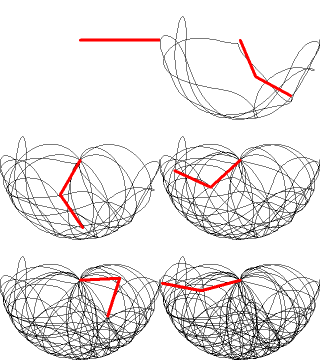
Or maybe this is the truer model of US politics:

animation of a double pendlum

Animation of a double compound pendulum showing chaotic behavior. (Via Wikipedia)

Posted in Agora | Tagged , | 2 Comments

Busybodies

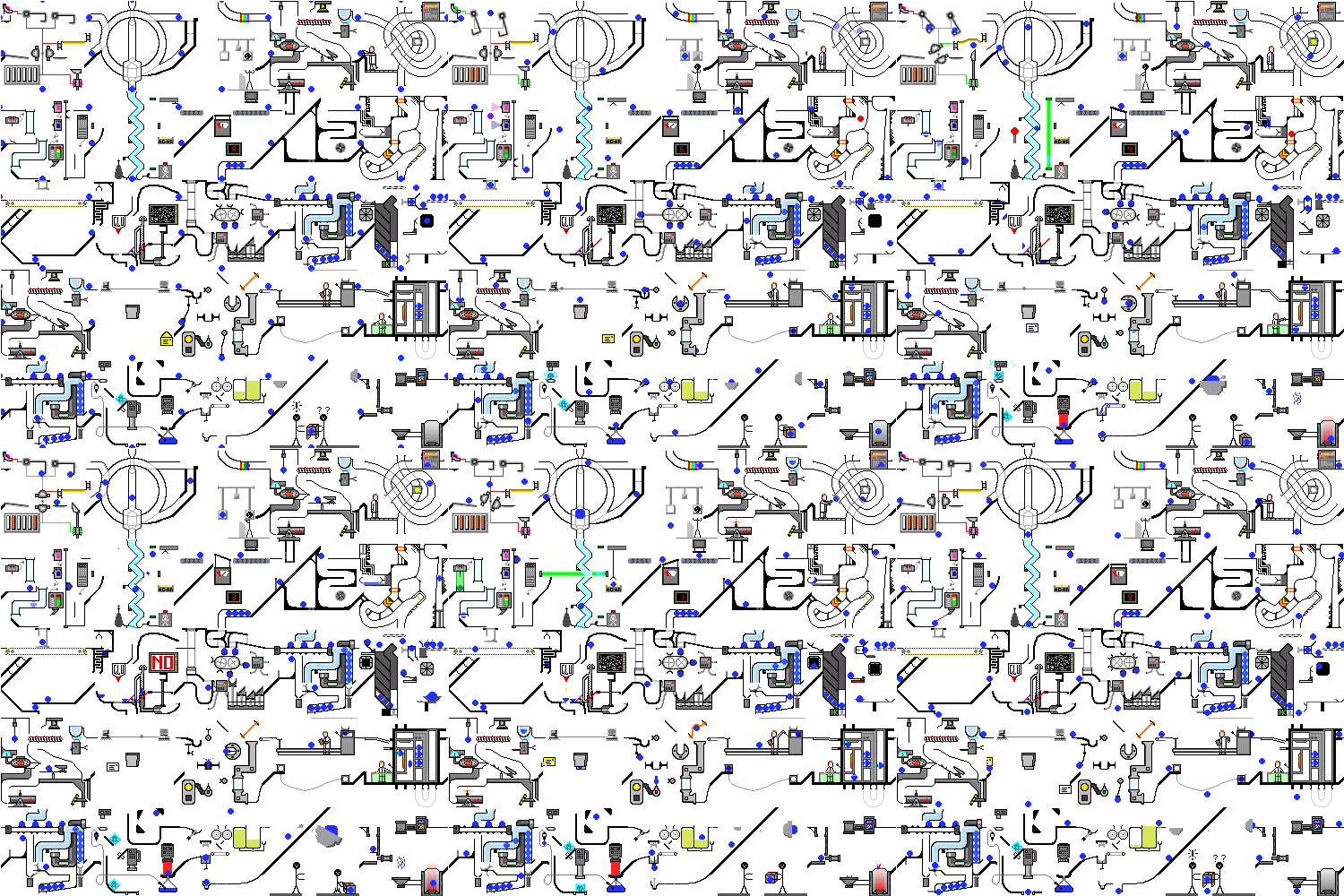
Something to take our minds off the chaos out there—from GifCities, a project of the Internet Archive.

a Rube Goldberg animated GIF[I wish I could give credit for this, but could not find who made it.]

It looks to me like you can tile the GIF and make a bigger one—the balls running off the right edge appear at the left edge, the ones falling through the floor reenter at the top, etc. Or we can just visualize the thing as a closed cylinder, or double cylinder (?!), and imagine the action continuing continuously, around and around in four directions …

Here’s something to calm us down:

skyline at night reflected in water

Posted in Random | Tagged | Leave a comment

Interdisciplinary

I wish I could give credit where it’s due, but I don’t know who came up with this gem. I also don’t know how long it’s been around. I found it on Facebook—an unexpected and pleasant payoff for my weekly scan there to make sure I’m not “missing” something really “important.” It’s a mathematical limerick:

a mathematical limerickMaybe you can come up with the English translation on your own. But let’s assume you can’t, or don’t care to try, so we can get right to it (and not hide it in the comments). Here it is:

A dozen, a gross, and a score
Plus three times the square root of four
Divided by seven
Plus five times eleven
Is nine squared and not a bit more.

Kinda cute, eh? It’s fun that it uses old-fashioned words for certain quantities.

Posted in Random | Tagged , , | Leave a comment

Geobully

To date, the crazed vengeful maniac known in some quarters as Yambo has not tried to rename the state of New Mexico. If he did, the purported state of “New America” (or “Trumpiana”?) would possibly put up some resistance. The Gulf of Mexico, on the other hand—a humble body of water with no attorney general—cannot push back on being renamed. It can, however, send ever more powerful storms into what continues to erroneously bill itself as “the land of the free and the home of the brave.” Revenge, yes. Unfortunately, this will only add to the misery inflicted on a woolly-eyed nation that elected a narcissistic bully. Yambo himself will be gone, sooner or later, leaving the sodden wreckage for generations to come.

Steve Herman post on Mastodon regarding the EPA changing the name of its Gulf of Mexico Division

This may seem trivial, in view of the truly horrendous things being perpetrated by the sinister minister without portfolio Elon Musk. In fact, geographical renaming stunts are most likely meant to distract us from the deeply damaging attacks on, and hyperpartisan infiltration into, the country’s public institutions. What’s disturbing is the compliance. It seems glaringly obvious that Trump has no authority to rename an international body of water. The world, looking on in bemused alarm, will continue to call it what everyone calls it. But if the hack he installed at an agency says to his staff, “Rename it,” someone on staff will be able to do it, and possibly be promoted for it.

On the plus side, we are seeing isolated attempts at resistance to what are clearly illegal or highly inappropriate actions. It is hard to believe they will be enough. If there is no snowball effect, leading to an avalanche, they will be the squeaks of mice under the elephant’s foot.

Posted in Agora | Tagged , , | 5 Comments

Немой

roiling mind

America has left me speechless.

Thoughts are roiling in my head, but it would be pointless to let them out.

This is the one exception.

I am speechless.

Posted in Agora | Tagged , | Leave a comment

Teatime

Many pages into Daniel Dennett’s latest opus, I’ve Been Thinking—by turns informative, entertaining, and maddening (“an engaging, vexing memoir with a humility bypass,” as the Guardian headline writer puts it)—one encounters a passage answering to the first two adjectives above, at least for this reader. It involves a time-honored habit of the tradition-bound British: pouring your tea into a cup containing milk, rather than the reverse, which is what a barbaric American would do, if such a Yank should, for some strange reason, think of putting milk in tea. (Whispered aside: I’ve actually done it. It’s not bad.)

cup of coffee on a chilly morning

A cup of coffee, not tea!

One of Dennett’s many, many good friends, Seymour Papert, spent some time in a London hospital and volunteered to wheel the tea wagon around to his fellow patients. He noticed how many of them insisted on having milk poured into their cup first, then the tea. He subjected them to a little test to see if they could tell the difference. Many of them could. Papert wondered: “What were they sensing?” What sets Papert apart from someone like, say, me is that he decided to take his wonderment a step further. In Dennett’s words (chapter 26):

Opportunistically, he decided to try for a simple, low-budget test first: he smeared some tea of both varieties on glass slides and put them under a microscope. Eureka! The tea poured into milk exhibited tiny globules of milk partly cooked by the hot tea; the milk poured into tea had long stringy strands of milk. Mystery solved.

Has anyone confirmed this result—both the physical findings and the ability of humans to detect (and, as a bonus, describe) the difference? Dennett doesn’t say, and in the true modern spirit of not taking advantage of the vast resources the internet places at one’s fingertips, I have not pursued the question further. Just sharing. 😉

Posted in Random | Tagged , | 2 Comments

Mathemagic

The following puzzle appeared in the October/November 2023 issue of the AARP member magazine.

What’s next?

Each number after the first is derived in the same way from the previous number. What is the number that logically follows 66?

1, 6, 21, 66, ____

Before we get to their solution, I’ll explain mine. (It turns out it is not technically correct, but I only realized that while I was typing the problem just now.)

In trying to get the number after 66, I worked from the differences between each of the preceding three pairs of numbers. What I came up with was: the difference between the first two numbers is 5 × 30; the difference between the second and third is 5 × 31; the difference between the third and fourth is 5 × 32. I figured the difference between the fourth number and the (currently unknown) fifth is 5 × 33, or 135, which would make the fifth number 66 + 135 = 201.

That indeed is the correct answer to the question “what is the next number in this sequence?” But my approach does not satisfy the condition exactly. My approach is systematic and sequential, but the operation is not the same throughout the process—I’m increasing the power by increments of 1 at each step. I’m not deriving the number “in the same way” from the previous number, which I (and probably you) take to mean “doing the same exact operation over and over.” The correct solution is the one they give: “For each number after the first, multiply by 3, then add 3.” Getting the right answer (appropriate number) is not the same as coming up with the “correct” solution (solving method).

Here’s the thing: I find their solution ugly. It looks like someone scratched out an equation, any old equation, made a sequence using it, and gave us the sequence for us to reverse engineer. Big whoop. Is mine more elegant? I’ll let the reader be the judge. Theirs can be stated more briefly than mine, but it seems like something a solver would have to arrive at by trial and error. What was my approach? Well, when I noticed that the difference between the first two numbers is 5 and that between the second and third is 15, it got me thinking about 5 as a factor to be investigated. The rest, as they say, is history.

What has me baffled now is the fact that two such divergent approaches both work. The next number in the sequence is identical using each approach:

(3 × 201) + 3 = 606 [AARP],

201 + (5 × 34) = 201 + 405 = 606 [TMW].

Presumably it will continue to be so. How are the two approaches related? How do I start solving this problem?

We know that

x0 = 1, x1 = 6, x2 = 21, x3 = 66 …

We can say that

xn+1 = (xn × 3) +3 [AARP]

is equivalent to

xn+1 = xn + (5 × 3n) [TMW],

where n is the position in the sequence, beginning at 0—i.e, the first number x0 = 1. (I may be butchering the proper mathematical presentation of my thinking, but them’s the breaks.)

This gets me wondering if the equations continue to produce equivalent results if we start at, say, 2. Excuse me while I check … It does not!

2, 9, 30, 93 … [AARP]

is obviously not the same as

2, 7, 22, 67 … [TMW].

Well, well. But despair not: maybe we just need to tweak the first equation—make it, say,

xn+1 = (xn × 3) +1 [AARPrev.1].

(Since, in the second slot, we need to get 7 instead of 9, let’s add 1 instead of 3 after multiplying.) We’ll let my equation stay as is. It seems rather less “fixable” than the other. When we start the sequence with 2, the revised AARP equation yields

2, (2 × 3) + 1 = 7, (7 × 3) + 1 = 22, (22 × 3) + 1 = 67 … [AARPrev.1].

Bingo! What if we start with 3? Let’s run my equation first:

3, 8, 23, 68 … [TMW].

Can we adjust the AARP equation to get this sequence? How about xn+1 = (xn × 3) – 1 (since we need to get 8 now in the second slot)?

3, (3 × 3) – 1 = 8, (8 × 3) – 1 = 23, (23 × 3) – 1 = 68 … [AARPrev.2].

So, to generalize, if we start the sequence with 1, the AARP equation adds 3 after multiplying by 3; if we start with 2, it adds (3 – 2) = 1; if we start with 3, it adds (1 – 2) = –1 (i.e., we start subtracting from now on, still in increments of 2). So, starting with 4:

4, 9, 24, 69 … [TMW],

4, (4 × 3) – 3 = 9, (9 × 3) – 3 = 24, (24 × 3) – 3 = 69 … [AARPrev.3].

This is all very nice, but I don’t feel that I’m any closer to seeing how the two equations relate. We incrementally add 1 to the starting number, but incrementally subtract 2 from the number we add in the AARP equation, quickly getting us into adding negative numbers (subtracting, although the fact we’re subtracting now seems a trivial, maybe merely accidental detail, of interest only to those who freak out when “positives” become “negatives”). One senses a connection, but I’m too mathematically dull to find it.
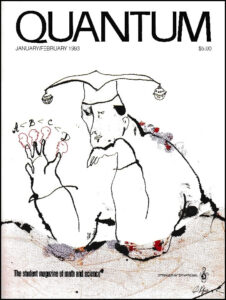
cover of Quantum magazine, Jan/Feb 1993

Michael H. Brill and Michael Stueben explored “A Magnificent Obsession: The Strange Story of Perfect (and Perfectly Useless) Numbers” in the January/February 1993 issue of Quantum. (Cover by Dmitry Krymov, illustrating a different article)

It’s curious that adding 1 to the starting number in the sequence simply adds 1 to all the numbers in the sequence. It’s obvious why this happens in the TMW equation: the numbers worked out in the parentheses never change, only the numbers added to them change (by 1, because the starting number changed by 1). That’s the beauty of not changing my equation! The behavior of the AARP equation is a bit more convoluted, but it gets to the same point as the TMW equation: all the numbers increase by 1. It apparently has to do with always multiplying by 3 but adding 2 less every time we change the starting number, but I can’t quite get a handle on how to explain it mathematically. (The more I think about it, the more it seems this is the sort of problem routinely encountered, and solved, in computer programming.)

Situations like this make me sad that number theory was never offered during my many years of incarceration—I mean, education. While editing Quantum I would encounter all sorts of interesting mathematical “genres” that I had never seen before: topology, group theory, non-Euclidean geometry, etc. Maybe one of these would have triggered something in me, in a way that calculus certainly did not. It may be that I was not suited for any of those other areas of mathematics either. In any case, a problem like this little teaser in an Old Fogey magazine gave me a fun few minutes shimmying up to the edge of real mathematics and gazing agape into the abyss.
Posted in Random | Tagged , | Leave a comment

Beastie

As part of our continuing series on the Wonderful World of Bugs, I invite you to take a look at this scary-looking thing that I felt crawling on my neck on May 10:

mystery bug

It’s about 2 cm long.
(Apologies for the poor focus, poor lighting—poor everything.)

I had no idea what it was. But, once again: Google to the rescue! (It’s wonderful how one can search on images to get context about the thing depicted.) Do you know what it is?

If you’re stumped, you’ll find the answer in the first comment.

Posted in Random | Tagged | 4 Comments