Squelch

From the New York Times today I learned about the controversy involving Rebecca Journey’s course “The Problem of Whiteness” at the University of Chicago (my alma mater).

Like many, if not most, modern controversies, this one begins with a misunderstanding (whether innocent or contrived, I will reserve judgment). Without full access to Prof. Journey’s mind, I will nonetheless hazard a guess that, in naming her course “The Problem of Whiteness,” she was not saying that whiteness is ipso facto a problem; that you, for instance, if you are white, are a problem (i.e., something that, in the vernacular, “makes things worse”). Yet it could easily be read that way, even by someone with no ax to grind. If Prof. Journey intended to be provocative, she unfortunately gave a golden opportunity to a provocateur.

Snell-Hitchcock Hall, University of Chicago (photo credit: Bryce Lanham, Wikimedia Commons)

Snell-Hitchcock Hall, where I bedded down for two years. (Photo credit: Bryce Lanham, Wikimedia Commons)

With five years of the U of C under my belt,* it is easy for me to read the course title as dealing with a problem in the sense of the four-color problem (in mathematics), or the problem of extreme income disparity (in economics and political science).** I would be very interested in examining the notion of “whiteness”: when and how did it arise? How has the concept evolved? How is the term used, and by whom, and for what reasons? What are the social and political consequences of “whiteness”? Similar questions have been asked about “blackness,” and about the concept of “race” in general. I am acquainted with various attempts to address these questions, much to my benefit, I believe, as a conscious (or at least aspiringly conscious) person of the 21st century.

And so: perhaps Prof. Journey could rename her course: “What is White?” Or simply: “Whiteness.” Something bland. Something “academic.” More cautious. Careful. More in keeping with University of Chicago style. /snark (Did I mention I’m a “product” of this venerable institution? Self-snarking goes with the territory.) Perhaps a course with such an anodyne title could fly under the radar of the self-proclaimed defenders of Free Speech (sweet Jesus, the Irony, it howls and rages and won’t go away). At any rate, it would not invite mind-numblingly stupid, time-wasting controversy.

It appears the university has taken steps to protect Prof. Journey’s person and privacy, and has affirmed her right to teach the course. These actions are commendable, but fall short. Why? Because the course has disappeared, perhaps forever. It is clearly a course that would expand the horizons of tuition-paying students who wish to take it. It has been driven from the classroom by the modern equivalent of a torch- and pitchfork-carrying mob. It is, in quasi-technical parlance, a crying shame.

It should be obvious by now that the “Chicago statement” on freedom of expression needs to be updated. It should be obvious that the “information wars” that are being waged nowadays are asymmetrical. The university lectern is no match for the global megaphone of any yahoo with an internet connection and a handful of social media accounts, coupled with a highly lucrative system of grievance amplification (Fox News, Breitbart, The Daily Caller—all mentioned by Schmidt when interviewed by the Times). I imagine those who drafted the statement have never personally experienced modern cyberharassment. I would urge them to put on their empathy caps and try to understand it more fully.

The question arises: what to do about a person like Daniel Schmidt, a member of the University of Chicago community who, in the name of free speech, succeeds in squelching it in his own institution? While the student newspaper, The Chicago Maroon, was able to fire him without worrying about “free speech” blowback, the university obviously cannot punish him for posting inflammatory opinions about a course he has not taken. This is the very stuff of modern life: people spouting off online about things they know little or nothing about. Does the university have an obligation to enter the online fray in defense of its faculty? I don’t see that happening, for many reasons, not least of which is the Whack-a-Mole Problem.

Can the university make it an expellable offense to post a faculty member’s or student’s contact information on social media? Schmidt argues that interested people can find that information, as it is publicly available. True. But Schmidt knows the online mob is lazy. Making them do some research is a deterrent—not preventative, just a deterrent. I think it’s a deterrent worth putting in place as a rule of U of C life.

Regardless of what the university decides to do about this and similar situations, I think it needs to publicly acknowledge (and broadcast widely) that what Schmidt did is an abuse of the “Chicago statement”; that it had the effect of shutting down legitimate academic speech; that it is abusive on the personal level; and that such behavior should find no quarter in an institution devoted to the free, peaceful, well-informed, and well-intentioned exchange of ideas. It also wouldn’t hurt it the university included the following in its statement of free speech principles: “A cherished attribute of life at the University of Chicago is intellectual humility.” It may not have an effect on a person like Daniel Schmidt, but it would be nice if the university said it out loud. It is what allows us to politely listen to ideas that strike us as strange or wrong or even dangerous. It is what allows us to learn. As an undergraduate I politely read and regurgitated the ideas of U of C economists. Some fifty years out I don’t espouse Chicago School economics. But I learned something back then. That used to be the point of going to college.

__________
* And you can easily guess approximately when that was by my use of U of C rather than the currently fashionable, undoubtedly mandated UChicago.

** This assumes that, even if one is a fan of extreme income disparity, one might be willing to entertain the proposition that there are side effects of this disparity that might need to be addressed—e.g., social instability (hence, a problem to be investigated academically).

Posted in Agora | Tagged , | 1 Comment

Unhappy

The headline for a New York Times op-ed piece: “There is No Happy Ending to America’s Trump Problem.” Stop the presses! Fixing the biggest mistake in U.S. history will not be easy or painless! Who’d’a thunk?

The task at hand is equally obvious: find the right bad ending, which will be anything that keeps Trump away from the Oval Office. (What makes it “bad” in the hand-wringers’ minds is the “damage” it will do to our longstanding political “traditions”—the unwritten rules that the Grifter in Chief has shredded and flushed already.) Yes, there is a chance the “bad choice” chosen will actually enhance the MAGA brand rather than damage it in the glazed eyes of Trump’s most addled followers. But it may also isolate them to irrelevance. It may give more ammo to his morally debased GOP acolytes in elected office and in the media. But it may also be the jab that bursts the Trumpian boil.

In any case, it’s Pick Your Poison time, America.

Jamelle Bouie, who persistently brings history to bear on the present in the most enlightening ways, points out another time the risk-averse counseled inaction so as not to fan the flames of discord.

National politics in the 1870s was consumed with the question of how much to respond to vigilante lawlessness, discrimination and political violence in the postwar South. Northern opponents of federal and congressional intervention made familiar arguments.

If Republicans, The New York Times argued in 1874, “set aside the necessity of direct authority from the Constitution” to pursue their aims in the South and elsewhere, could they then “expect the Democrats, if they should gain the power, to let the Constitution prevent them from helping their ancient and present friends?”

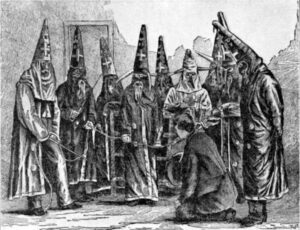
Klu Klux Klan in 1870

Depiction of Ku Klux Klan in North Carolina in 1870, based on a photograph taken under the supervision of a federal officer who seized Klan costumes. (Wikipedia)

The better approach, The Times said in an earlier editorial, was to let time do its work. “The law has clothed the colored man with all the attributes of citizenship. It has secured him equality before the law, and invested him with the ballot.” But here, wrote the editors, “the province of law will end. All else must be left to the operation of causes more potent than law, and wholly beyond its reach.” His old oppressors in the South, they added, “rest their only hope of party success upon their ability to obtain his goodwill.”

To act affirmatively would create unrest. Instead, the country should let politics and time do their work. The problems would resolve themselves, and Americans would enjoy a measure of social peace as a result.

Of course, that is not what happened. In the face of lawlessness, inaction led to impunity, and impunity led to a successful movement to turn back the clock on progress as far as possible, by any means possible.

Our experience, as Americans, tells us that there is a clear point at which we must act in the face of corruption, lawlessness and contempt for the very foundations of democratic society. The only way out is through. Fear of what Trump and his supports might do cannot and should not stand in the way of what we must do to secure the Constitution from all its enemies, foreign and domestic.

Posted in Agora | Tagged , , | Leave a comment

Tired

You may be tired of Covid, but Covid is not tired of you. Let that sink in. And think about how so many big proud hominids are letting a microscopic bit of pseudo-life outsmart them.

SARS COVID-19

Scientifically accurate atomic model of the external structure of the Severe Acute Respiratory Syndrome CoronaVirus 2 (SARS-CoV-2), a strain (genetic variant) of the coronavirus that caused Coronavirus disease (COVID-19), first identified in Wuhan, China, during December 2019. Image credit: N+1, a popular science online publication of Russia (https://nplus1.ru/) via Wikimedia Commons.

Posted in Agora | Tagged , , | 1 Comment

Christofascism

One year to the day after musing about the diet of fireflies, I am awash in bitter thoughts in the aftermath of Roe v. Wade being overturned by the U.S. Supreme Catholic Court.

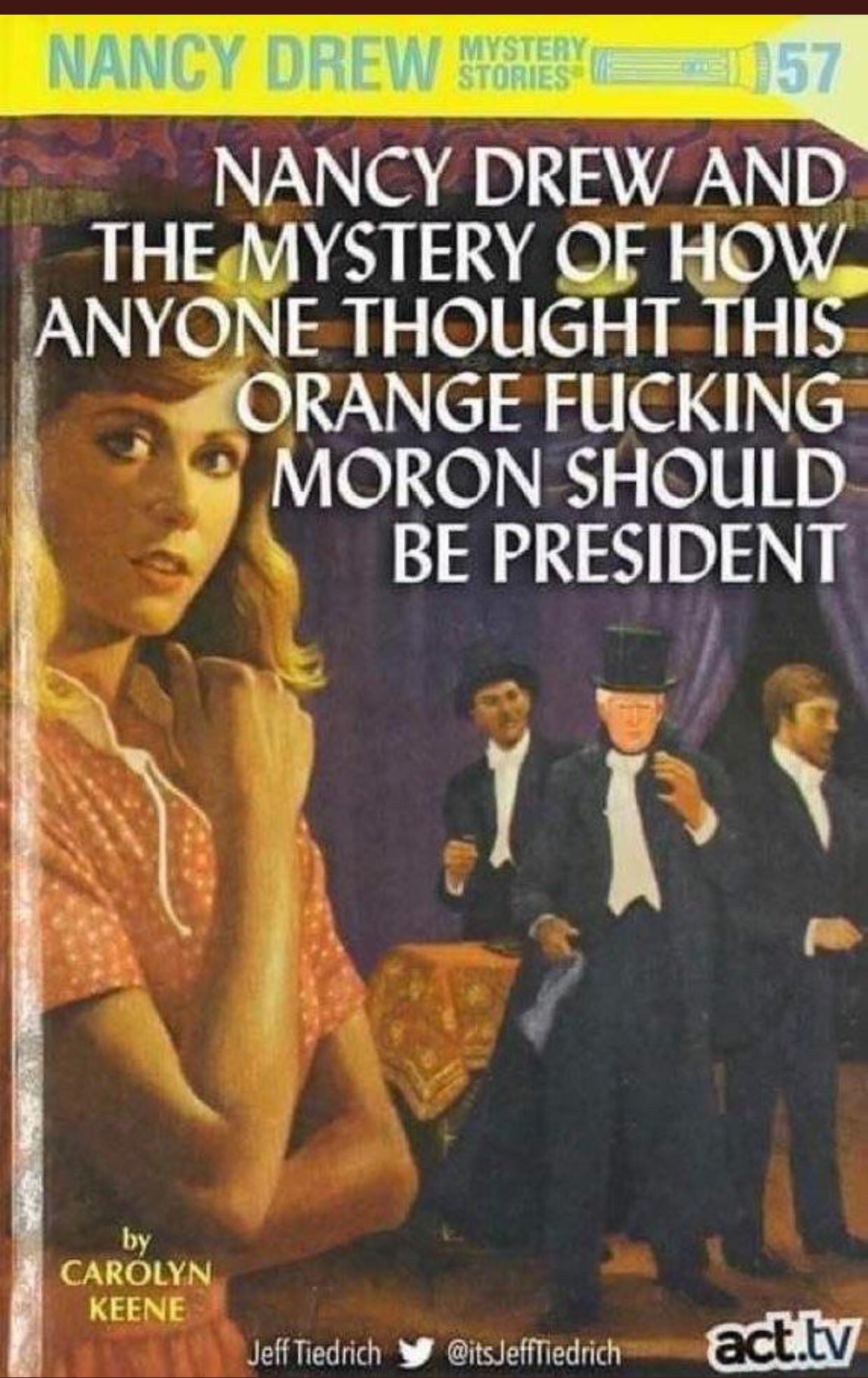
Ignore abortions like you ignore school shootings

via Twitter – @WUTanKids

Yes, just days before, the USSCC threw out reasonable gun regulation on behalf of a mythical right to personally carry firearms just about anywhere in public (just not near the homes of USSCC judges).

Posted in Agora | Tagged , | 4 Comments

Fireflummoxed

lightning bug on mint leafAs I was having a beer on our front steps after my daily bike ride, a lightning bug landed on a leaf in a pot of mint on one of the steps. It stayed there for some time (it may be there still), but it did nothing but sit. In other words, it was not munching mint. And it got me wondering: what do fireflies (their other name) eat?

In years gone by, this simple question would probably have required a significant expenditure of time and a healthy bit of work to answer, probably a trip to the library—unless one happened to have an entomologist or an amateur lightning bug expert at one’s elbow. But since this is now, and since my cellphone was at hand, the answer was also within immediate reach.

Judging from the query autocompletion at Google, it is clear I am not the first person, by far, to ask this question. And part of the answer is, frankly, a little disturbing.

According to the National Wildlife Federation, “[f]irefly larvae eat snails, worms, and slugs, which they inject with a numbing chemical to disable.” So far so good (unless you’re a snail, worm, or slug). The entry continues: “Adults eat other fireflies, nectar, or pollen, although some don’t eat at all.”

Fireflies eat other fireflies! Lightning bugs are cannibals!

Am I the better for knowing this?

Well (I tell myself), maybe this is one of those who “don’t eat at all.”

Posted in Random | Tagged , , , , | 1 Comment

Dreamwork

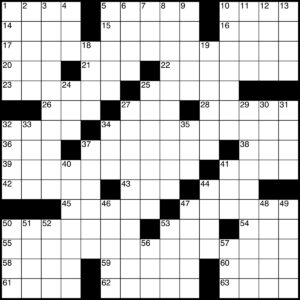
blank crossword puzzle grid

Credit: Wikimedia

Last night, in the midst of typically inchoate and unrememberable dreams, I came up with two crossword clues that I somehow did remember:

1. _ _ _ _ Tsar did not place this atop Kremlin tower

2. _ _ _ _ _ _ _ _ Hag dispensing shaved-ice treat?

See the first comment for answers, if necessary.

It is probably worth mentioning that habitually the last thing I do before bed is fill in several online crossword puzzles. As far as I know, this is the first time I created clues while asleep.

Posted in Random | Tagged , , | 2 Comments

Hydrosonic

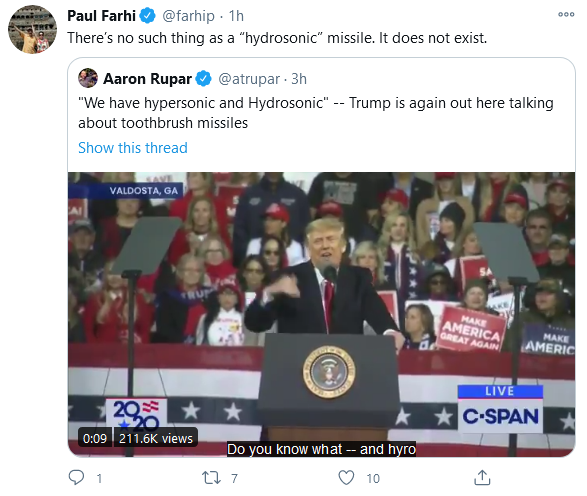
Months ago, Trump elicited guffaws in the non-Trumpist press and social media when he bragged about an amazing new “hydrosonic missile” purportedly under development. In the intervening time he has repeated the phrase—today, for instance:

Dear Leader never misspeaksNote how he uses both the correct and incorrect words. Very often when Trump misspeaks, he repeats the error and improvises on it briefly as if it were the word he actually intended to use. He is doing something similar here. The listener is meant to conclude that Trump did not make a mistake (months ago, when he first mentioned the “hydrosonic missile”); that, in fact, Trump never makes a mistake, never suffers even an innocent slip of the tongue, because the brilliant Donald Trump is just never wrong. The working assumption here, giving him the (undeserved) benefit of the doubt, is that Trump knows “hydrosonic” is … not wrong, no—just not the word some people use for it.

This brings to mind an exquisite footnote in Hannah Arendt’s The Origins of Totalitarianism. In a book laden with footnotes, this one drops before she is even out of the first page, and in fact is longer than the body text on that page. Here it is, in its entirety:

The “magic spell” that Hitler cast over his listeners has been acknowledged many times, latterly by the publishers of Hitlers Tischgespräche, Bonn, 1951 (Hitler’s Table Talks, American edition, New York, 1953; quotations from the original German edition). This fascination—“the strange magnetism that radiated from Hitler in such a compelling manner”—rested indeed “on the fanatical belief of this man in himself” (introduction by Gerhard Ritter, p. 14), on his pseudo-authoritative judgments about everything under the sun, and on the fact that his opinions—whether they dealt with the harmful effects of smoking or with Napoleon’s policies—could always be fitted into an all-encompassing ideology.

Fascination is a social phenomenon, and the fascination Hitler exercised over his environment must be understood in terms of the particular company he kept. Society is always prone to accept a person offhand for what he pretends to be, so that a crackpot posing as a genius always has a certain chance to be believed. In modern society, with its characteristic lack of discerning judgment, this tendency is strengthened, so that someone who not only holds opinions but also presents them in a tone of unshakable conviction will not so easily forfeit his prestige, no matter how many times he has been demonstrably wrong. Hitler, who knew the modern chaos of opinions from first-hand experience, discovered that the helpless seesawing between various opinions and “the conviction … that everything is balderdash” (p. 281) could best be avoided by adhering to one of the many current opinions with “unbending consistency.” The hair-raising arbitrariness of such fanaticism holds great fascination for society because for the duration of the social gathering it is freed from the chaos of opinions that it constantly generates. This “gift” of fascination, however, has only social relevance; it is so prominent in the Tischgespräche because here Hitler played the game of society and was not speaking to his own kind but to the generals of the Wehrmacht, all of whom more or less belonged to “society.” To believe that Hitler’s successes were based on his “powers of fascination” is altogether erroneous; with those qualities alone he would have never advanced beyond the role of a prominent figure in the salons. [The Origins of Totalitarianism (new edition with added prefaces): New York, Harcourt (Harvest), 1976, p. 306]

Granted, there is much here that does not apply directly to Trump—e.g., that the “fascination” is restricted to the leader’s inner circle, or that the leader picks only one idea and sticks with it despite evidence that undermines or even nullifies it, or that all his opinions fit into a broad ideology (unless one takes Trump-the-person to be an ideology). Trump is notorious for changing his tune repeatedly and shamelessly—i.e., without any visible or audible indication that he was saying something drastically or diametrically different mere days (or minutes) ago.

What does resonate, however, is the way the leader takes advantage of his adherents’ “opinion fatigue” and projects a certitude that they gladly accept and freely regurgitate, in sound bites and slogans. Any skepticism that might naturally be directed at a leader is magically redirected to anyone who expresses skepticism about the leader, or who merely reports facts that the leader has rejected as “fake.”

This is only one aspect of the Trump phenomenon, of course. One might spend a fruitful few minutes examining the play-acting that he and his followers engage in. He is, after all, a product of “reality TV,” a massive pretense millions have happily immersed themselves in; and he did have a long run of pretending to be a successful businessman. The crowds at Trump’s rallies resemble those at rock concerts more than they evoke images of a Nuremburg rally. But there are hard truths underlying his followers’ chants and antics, which can be seen in the symbols they bring to the events (e.g., Confederate flags) and the white supremacism, sexism, xenophobia, and resentments (of all sorts—e.g., resentment of those with expertise) that Trump has freed them to express publicly.

As Paul Farhi notes, the hydrosonic missile “does not exist.” It is just one of myriad things Donald Trump spends time talking about that do not exist. He has filled the public sphere and all of our lives with non-existent crap—Gresham’s Law applied to the national discourse.

* * * * *

A few pages after the footnote cited above, one encounters another stretch of text that resonates today:

Totalitarian movements are possible wherever there are masses who for one reason or another have acquired the appetite for political organization. Masses are not held together by a consciousness of common interest and they lack that specific class articulateness which is expressed in determined, limited, and obtainable goals. The term masses applies only where we deal with people who either because of sheer numbers, or indifference, or a combination of both, cannot be integrated into any organization based on common interest, into political parties or municipal governments or professional organizations or trade unions. Potentially, they exist in every country and form the majority of those large numbers of neutral, politically indifferent people who never join a party and hardly ever go to the polls.

It was a characteristic of the rise of the Nazi movement in Germany and of the Communist movements in Europe after 1930 that they recruited their members from this mass of apparently indifferent people whom all other parties had given up as too apathetic or too stupid for their attention. The result was that the majority of their membership consisted of people who never before had appeared on the political scene. This permitted the introduction of entirely new methods into political propaganda and indifference to the arguments of political opponents; these movements not only placed themselves outside and against the party system as a whole, they found a membership that had never been reached, never been “spoiled” by the party system. Therefore they did not need to refute opposing arguments and consistently preferred methods which ended in death rather than persuasion, which spelled terror rather than conviction. They presented disagreements as invariably originating in deep natural, social, or psychological sources beyond the control of the individual and therefore beyond the power of reason. This would have been a shortcoming only if they had sincerely entered into competition with other parties; it was not if they were sure of dealing with people who had reason to be equally hostile to all parties. [The Origins of Totalitarianism, pp. 311–12]

Leaving aside the question of the legitimacy or correctness of the views enunciated by Trump’s core (or, one might say, hard-core) followers, it would seem reasonable to describe these opinions as simpleminded (or, at the very least, simple). This observation would jibe with Arendt’s description of the masses that entered politics for the first time in the periods and places cited above. Also striking is her assertion that these people had no interest in refuting opposing arguments, preferring intimidation to persuasion.

That so many of today’s Trumpists believe in a virtually unlimited Second Amendment right to “bear arms” and are not shy about showing up in force, armed with semiautomatic rifles and other weaponry, at politically sensitive venues (demonstrations, legislature buildings, locations where votes are being tabulated, the homes of government officials, etc.), and that so many of them utter death threats in person and online against their enemies (viz, fellow citizens who disagree with them), should be seen as a seriously troubling sign of a slide toward terrorism in US politics. It may be tempting to dismiss the antics of armed citizens as theater (as noted above) and nothing more. But history is clearly warning us that we ignore such manifestations of the totalitarian (or authoritarian) mindset at our own peril.

One final note: Trump, the Republican Party, and those who support them are dedicated to maintaining—and expanding—minority rule in the United States of America. After decades of ruthlessly exploiting the structural defects in the US system that allow for the less numerous to work their will on the entire polity, instituting less popular policies rather than enacting the wishes of most of the citizenry, the emergence of a previously inert or malleable base sympathetic to a “strong man” (or, more precisely, a lockstep authoritarian clique) has added a new arrow (so-called “populism”) to the GOP’s quiver, paradoxically supplementing the virtually untrammeled power of Big Money.

Posted in Agora | Tagged , , , | 1 Comment

Spiders

It appears that my beloved baseball team, the Cleveland Indians, is seriously considering a name change.

While many thought the only problem with the team’s image was the ignobly grinning Chief Wahoo, others insisted the name itself is racist, even if not intentionally derogatory (in fact, it is purported to have been adulatory).

The momentum achieved by Black Lives Matter has spilled over into other areas of public life that have managed to escape change (e.g., the local football club, the Washington Redskins, is also—it says—looking at changing its name). This may finally be the moment to redress these persistent sore points in what should be a commonly enjoyed pastime, free from the stresses and slights of everyday life.

With that I endorse the nascent movement encouraging the Cleveland franchise to resurrect a name it used more than a century ago: the Cleveland Spiders. This was the team’s name when the fabled Penobscot Indian Louis Sockalexis thrilled Clevelanders with his dazzling play. It is said the team later became officially known as the Indians because of his association with it. Be that as it may, times have changed, and one does not have to be an Indian to feel that the name is insensitive.

If the popularity of Cleveland Spiders T-shirts in online stores, before serious talk of renaming arose, is any indication, the name change may actually be welcomed by a large portion of the fan base. Will it be universally liked? No. What is? “Cleveland Indians” certainly is not, yet it has managed to persist. Will it be sufficiently liked? I think it would be.

Someone (I wish I could credit them by name) has nicely incorporated the current Cleveland logo (the “block C”) into a Spiders logo. And to replace the century of affectionately referring to the team as “the Tribe,” we can call them the Racks, short for arachnids, with an echo of “Cleveland Rocks.”

The Cleveland Spiders. Catch the Yankees and the Red Sox in your beautifully engineered web. Race around the bases on your crazy eight legs. Be proud of your place in the ecosystem and in the moral universe.

You can do it, Cleveland. You will not be destroying history—you will be making it.

If, however, Cleveland insists on naming its team after an ethnic group, let it be the Cleveland Slovenians, in honor of the fact that the city has been home to the largest population of Slovenians outside of Slovenia.

Posted in Agora | Tagged , , , | 3 Comments

Conway

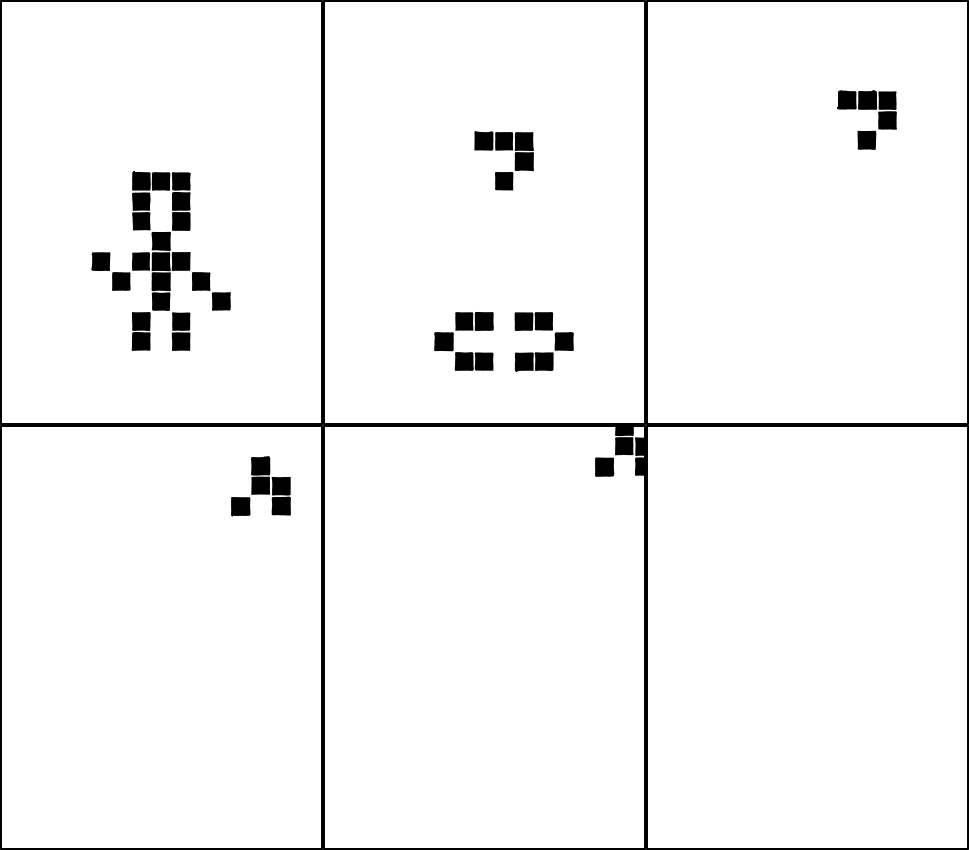
disappearing man in Game of Life

Randall Munroe’s homage to Conway, riffing on Game of Life.

I am not a mathematician, but I played one on TV in a magazine—Quantum: The Magazine of Math and Science. That is how I learned about John Horton Conway, who passed away this week from complications of COVID-19.

Conway wrote five articles for Quantum, which was aimed primarily at students. The pieces might not have seen the light of day but for the midwifery of Quantum’s US Editor in Chief for Mathematics, William P. Thurston, a Princeton colleague. To accommodate Conway’s work habits, Thurston would come to Conway’s office and plop himself down next to him, staying there until the article was finished—so the story goes.

The computer simulation Game of Life is probably his claim to fame in the wider world of nonmathematicians. Absent Quantum even I might have stumbled upon it. It seems anyone with a computer in those days (i.e., the days of yore, aka the late 20th century) knew about it and could run it on their crummy PCs—it packed a lot of bang for its computational buck.

John Conway’s contributions to Quantum’s “Mathematical Surprises” column:

Posted in Random | Tagged , | Leave a comment

Terminology

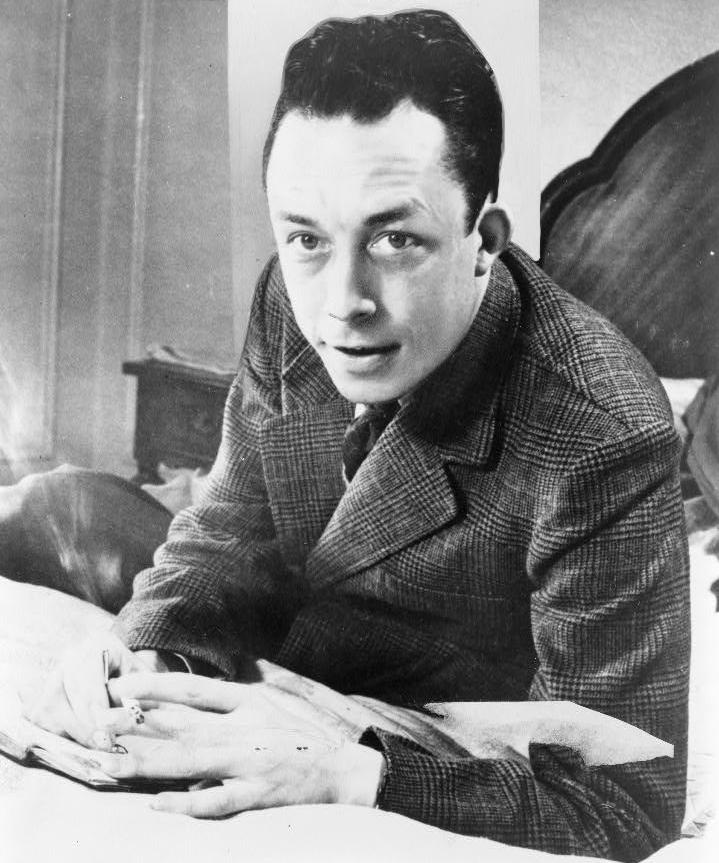
Albert Camus“Please answer me quite frankly. Are you absolutely convinced it’s plague?”

“You’re stating the problem wrongly. It’s not a question of the term I use; it’s a question of time.”

“Your view, I take it,” the Prefect put in, “is this. Even if it isn’t plague, the prophylactic measures enjoined by law for coping with a state of plague should be put into force immediately?”

“If you insist on my having a ‘view,’ that conveys it accurately enough.”

The doctors confabulated. Richard was their spokesman:

“It comes to this. We are to take the responsibility of acting as though the epidemic were plague.”

This way of putting it met with general approval.

“It doesn’t matter to me,” Rieux said, “how you phrase it. My point is that we should not act as if there were no likelihood that half the population would be wiped out; for then it would be.”

—Albert Camus, The Plague (Vintage International) (pp. 50–51). Knopf Doubleday Publishing Group. Kindle Edition.

It matters not whether Trump’s behavior is intentionally malevolent or incidentally malicious; whether he is clinically or colloquially insane; whether his narcissism is unprecedented or typical of autocrats. It is not a question of what terms we use.

The nation’s governors, career bureaucrats (long-serving, long-suffering, overwhelmingly competent), and others have been hard at work, trying to minimize the effects of COVID-19. The way they have stepped up and are doing their jobs in the face of the unnatural disaster occupying the White House—who wasted time with the profligacy he has shown in every aspect of his shameful life—cannot be overpraised. They are all acting as though the person in charge is wholly incapable of doing the right thing. They need not say it out loud.*

Thankfully, recovering Republicans like George Conway and Rick Wilson are saying it out loud. The ever deferential mainstream media at long last are sort of saying it out loud. “It” is this: Trump cares only about himself; Trump lies like the rest of us breathe; Trump is nasty to anyone who does not do his bidding; Trump’s ego is cosmic while his curiosity is micron-thin; Trump’s attention span is measured in milliseconds; Trump lives in the everlasting present available only to those who are super-rich or pseudo-super-rich; Trump’s ignorance is on a par with his unearned certitude; the chronologically 73-year-old Trump possesses deep antiwisdom, the smart-alecky “street smarts” of someone who got it from the movies and who would not last a week on real streets; and so on.

“It” encompasses a lot of fetid stuff. And it has been there from the very beginning. And it will be an eternal mystery how anyone missed it, it was so huge.
__________
*Some of them cannot even say objectively true non-Trump-centric things out loud and stay where they can do some good (such is the petty petulance of the man-boy up top).

Posted in Agora | Tagged , , | 2 Comments