
It’s so nice to stumble on some good news. I think I’ll sit back and enjoy it …
While I’m at it, I’ll let a bloggy smile turn into a good laugh (“stuart”’s comment)—as long as I don’t tip my chair back too far and end up on the floor.
It’s so nice to stumble on some good news. I think I’ll sit back and enjoy it …
While I’m at it, I’ll let a bloggy smile turn into a good laugh (“stuart”’s comment)—as long as I don’t tip my chair back too far and end up on the floor.
Now that warrantless wiretaps have apparently become part of the American way of life, can physical searches without a warrant be far behind?
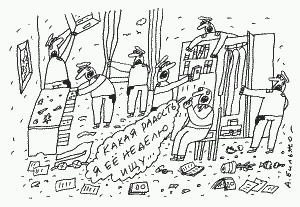
“Oh, wow—I’ve been looking for this for a week!”
[Cartoon by Andrey Bilzho] (who? here!)
Why would a play that ran successfully in London and was headed for New York City suddenly have the rug pulled out from under it?
Rachel Corrie, a young American peace activist, died three years ago beneath an Israeli bulldozer in front of a Palestinian pharmacist’s house in Gaza. She was 23 years old, and she left some words behind. Her words don’t clarify the murky circumstances surrounding her death, but they paint a moving picture of her life and her beliefs, according to those who have seen My Name is Rachel Corrie in London.
The Nation has attempted to answer the question posed above, in an editorial (“An American Inquisition?”) and an article by Philip Weiss (“Too Hot for New York”). Weiss’s article shows many people dancing around the elephant in the room, everyone reluctant to pinpoint the cause. And, truly, it seems the cause is too diffuse to capture in a word or phrase. But the general outlines emerge, and Weiss produces them at the article’s end, after quoting theater blogger George Hunka’s description of the controversy as “an extraordinarily rare picture of the ways that New York cultural institutions make their decisions about what to produce.”
Hunka doesn’t use the J-word. Jen Marlowe does. A Jewish activist with Rachelswords.org (which is staging a reading of Corrie’s words on March 22 with the Corrie parents present), she says, “I don’t want to say the Jewish community is monolithic. It isn’t. But among many American Jews who are very progressive and fight deeply for many social justice issues, there’s a knee-jerk reflexive reaction that happens around issues related to Israel.”
Questions about pressure from Jewish leaders morph quickly into questions about funding. Ellen Stewart, the legendary director of the theatrical group La MaMa E.T.C., which is across East 4th Street from the [New York Theatre] Workshop, speculates that the trouble began with its “very affluent” board. Rachel’s father, Craig Corrie, echoes her. “Do an investigation, follow the money.” I called six board members and got no response. (About a third appear to be Jewish, as am I.) This is of course a charged issue. The writer Alisa Solomon, who was appalled by the postponement, nonetheless warns, “There’s something a little too familiar about the image of Jews pulling the puppet strings behind the scenes.”
Perhaps. But [NYTW artistic director James] Nicola’s statement about a back channel to Jewish leaders suggests the presence of a cultural lobby that parallels the vaunted pro-Israel lobby in think tanks and Congress. I doubt we will find out whether the Workshop’s decision was “internally generated,” as [Pulitzer Prize-winning playwright Tony] Kushner contends, or more orchestrated, as I suspect. What the episode has demonstrated is a climate of fear. Not of physical harm, but of loss of opportunities. “The silence results from fear and intimidation,” says Cindy Corrie [Rachel Corrie’s mother]. “I don’t see what else. And it harms not only Palestinians. I believe, from the bottom of my heart, it harms Israelis and it harms us.”
Kushner agrees. Having spent five months defending Munich, he says the fear has two sources: “There is a very, very highly organized attack machinery that will come after you if you express any kind of dissent about Israel’s policies, and it’s a very unpleasant experience to be in the cross hairs. These aren’t hayseeds from Kansas screaming about gays burning in hell; they’re newspaper columnists who are taken seriously.” These attackers impose a kind of literacy test: Before you can cast a moral vote on Palestinian rights, you must be able to recite a million wonky facts, such as what percentage of the territories were outside the Green Line in 1949. Then there is the self-generated fear of lending support to anti-Semites or those who would destroy Israel. All in all, says Kushner, it can leave someone “overwhelmed and in despair—you feel like you should just say nothing.”
Who will tell Americans the Middle East story? For generations that story has been one of Israelis as victims, and it has been crucial to Israeli policy inasmuch as Israel has been able to defy its neighbors’ opinions by relying on a highly sympathetic superpower. Israel’s supporters have always feared that if Americans started to conduct the same frank discussion of issues that takes place in Tel Aviv, we might become more evenhanded in our approach to the Middle East. That pressure is what has stifled a play that portrays the Palestinians as victims (and thrown a blanket over a movie, Munich, that portrays both sides as victims). I’ve never written this sort of thing before. How moving that we have been granted that freedom by a 23-year-old woman with literary gifts who was not given time to unpack them.
I’ve noted many times that one is more likely to find an open, multisided discussion of the Palestinian issue in the Israeli press than in the American media. Kudos to The Nation.
On the broader issue of the power and influence of the “Israel lobby,” see this recent article by two American scholars—in the London Review of Books.
Senator Russ Feingold of Wisconsin has introduced a resolution to censure the President of the United States over his illegal wiretapping activities. Feingold deserves all the support we can give him. If you ever wanted to cosponsor a Senate bill, here’s your chance. (Don’t let your desire for impeachment stop you.)
Bonus link: coverage of Sandra Day O’Connor’s speech at Georgetown University in which she warned of the danger of the US edging towards dictatorship if the Republican Party’s rightwingers continue to attack the judiciary.
Boy, that last entry (“Shifting”) was a stinker, wasn’t it?
In the meantime I stumbled upon the Big Guy’s blog, and I can’t figure out whether it validates the effort of all us myriad scribblers* or invalidates it.**
__________
*I mean, if He does it …
**What’s left to say, really?
A friend at work gave me an old bicycle (a Giant—that’s the name, don’t blame me). After I added a few essentials for commuting safely (rear-view mirror, front and back lights, etc.), the bike was ready to serve as a backup to my old Trek hybrid (which badly needs a new middle chain ring—on order from a shop in New York City).
All bikes are a little different and take some getting used to. The Giant has slightly smaller wheels but with wider rims and thus bigger tires, so the center of gravity has changed a bit. But the main difference is the shifters. The Trek has the newer click-shifters, while the Giant has the old “continuous” shifters. Alternating bikes is like switching between a mandolin and a violin (i.e., between a fretted and fretless instrument).
Since I play the violin and haven’t touched a mandolin for years, this is perfectly fine. The Giant also brings back fond memories of my Fuji road bike, which had lever shifters on the down tube. (Bicyclists sure are a fruity bunch, aren’t they?)
The local PBS station is begging for money again, and to get our attention they’re running old episodes of Julia Child‘s The French Chef. Last Saturday she made several dishes using potatoes. It was the first installment, apparently, from 1963— “in glorious black and white,” as they say. She didn’t manage to flip the first potato pancake— “The main thing is, you need the courage of your convictions,” she said before she tried it. Problem was, the mixture was still too runny and the attempt was a flop, but she recovered well: “The nice thing about cooking is, when you make a mistake, you just make something else out of it.” She succeeded the second time, a little later, and I’m sure the viewers in that distant time cheered and fell in love with Julia.
Today was lobster day with the well-preserved 1970s-era Julia (now in “living color,” as they say). Her delivery was smoother, though she still had that touching way of looking at the camera (cameraman?) expectantly every time she shifted to another counter or table. She had broad selection of lobsters—one pound up to “Bertha the Behemoth.” You want the lively ones, she said, as the one she placed on the counter played dead. She continued talking about the different sizes, and soon she had one that actually moved. “This is what you want,” she exclaimed, as she got the thing to curl its tail.
We all know you have to boil lobsters alive. Did you know you should put them in head first? Yes. It’s only humane. That’s the easy part, in a way. It’s eating the things that is so darn disgusting. To me. Julia showed how to do it—the tools you need, the techniques that work best, what to eat and what to throw out. I thought: yech. She kept saying how indescribably tasty the meat is, the meat from the legs and the meat from the chest and so on, each tasty in its own way, and having tasted lobster I could understand her point if not her enthusiasm, but still I thought: yech.
Enough about lobster. On to meat in general. Often as I head out to hunt for a lunch that frequently consists of a blackened-chicken burrito or gyro, I think: would I eat this stuff if I actually had to kill the animal and prepare the meat myself? How many people nowadays would? Could I casually wring a chicken’s neck, like our great-great-grandmothers might have done; or shoot an elk, skin it, gut it, and so on?
I suppose if I were living in an African savanna, my empty stomach gurgling, I might chase down a wild animal and dispatch it. But here I am, in modern America—dozens of other people do all the dirty work for me. I get my meat in a very pretty form, on a plate or between slices of bread. Sometimes it doesn’t really look like meat—like those nifty round things you find on pizzas. It certainly never looks like an animal, unless it’s a fish.
There’s a passage in Berlin Alexanderplatz that comes to mind whenever I think about this. The author describes the activities of a slaughterhouse in language that varies from bureaucratic to elegiac, brutally anatomical to ironically poetic. It’s an assembly line of death, but for the men it’s all in a day’s work.
A man in a linen smock ambles through the corridor, the pen opens, he steps in between the animals with a stick; then, once the door is open, they rush out, squealing, grunting, and screaming. They crowd along the corridors. Across the courtyards, between the halls, he drives them up, those funny bare creatures with their jolly fat hams, their jolly little tails, and the green and red stripes on their backs. Here you have light, dear pigs, and here you have dirt, just give a sniff, go ahead and grub a while, for how many minutes longer will it be? No, you are right, one should not work by the clock, just go on sniffing and grubbing. You are going to be slaughtered, there you are, take a look at the slaughter-house, at the hog slaughter-house. There exist old houses, but you get a new model. It is bright, built of red brick, from the outside you might take it for a locksmith’s workshop, for a machine-shop, an office-room, or a drafting room. I am going to walk the other way, dear little pigs, for I’m a human being, I’ll go through this door, we’ll meet again, inside.*
I do the text an injustice by excerpting it, because the effect builds over fifteen pages (with a brief interlude). It’s horrific on many levels, and in the context of the book it raises the question of the effect of such mechanized killing on the persons who perform it and on society as a whole. At any rate, the passage by all rights should have made me a vegetarian. Clearly I lack the courage of my convictions.
The American Indians, from what I’ve been told, would thank an animal before killing it. Because they do not make a sharp distinction between other animals and themselves, the last line in the quoted passage above would not make sense to them. Their world is not divided into one where bison live and another where human beings live. The spiritual “economy” of humans and animals is fundamentally different from the European model we have inherited. An animal that allows itself to be killed and used for food or clothing is making a gift of itself, and attention is paid to all the proper spiritual aspects of gift-giving and gift-receiving, including the responsibilities of humans toward their fellow creatures.
How much of this is true and how much I dreamed up, I can’t say. But I’d like to remember it more often when I eat a hamburger.
__________
*Alfred Döblin: Berlin Alexanderplatz. Tr. Eugene Jolas. New York: Frederick Unger, 1983, p. 175.
Twenty years ago today, Gabrielle turned one, and the weather was exactly like today: sunny, breezy, and unseasonably warm (77°F, as we speak). We had a picnic on the grass in front of our apartment building on 40th Place. I won’t say it seems like yesterday, but it doesn’t seem like 20 years either.
The weather is similar in Boston today—10 degrees cooler, but still quite fine for someone who doesn’t much care for winter weather. Despite all her intricate plans for the day, she knew the weather might throw a wrench in them. She lucked out.
A friend gave her a tiara with the number 21 that lights up, which she wore to her Spanish class. Her professor has a thing about tiaras, it turns out, and asked to wear it as she administered today’s quiz. Some of the best things in life are unplanned. (For me, all of them are. Gabrielle got her planning genes from somewhere else.)
I expect March 10, 2026, to be sunny, breezy, and unseasonably warm.
Noting the rise in anti-Arab racism and bigotry against Muslims in the US, Juan Cole dug deep in the Quran on Thursday to bust up the “clash of civilizations” meme. The Muslims are pretty much like us Christians and Jews, don’t you see?
One commenter does see, and doesn’t like what he sees:
Give me a break.
The reason why the Romans were opposed to the Christians, and the kafir to the early Muslims, is that both those groups are against pluralism. The infidels did not declare war on the early Muslims, the early Muslims declared war on them.
Every anti-pluralist impulse in the world today can be traced to the eradication of traditional religion in favor of monotheism. [link added]
Be that as it may, recent events in Missouri expose what can only be described as a monotheistic agenda and resistance to it—by monotheists! That would seem to indicate the level of fundamental pluralism in the United States today, leaving aside the question of monotheistic pluralism, which is where we began (above). Here’s the text of the proposed legislation in Missouri, here is an explanation of how Muslims view polytheism and atheism, and here’s an American atheist’s cri du coeur.
Periodically I receive a little magazine, Tableau, sent to escapees from the Division of the Humanities at the University of Chicago. The Fall 2005/Winter 2006 issue reminded me that Wayne Booth had died and informed me that Paul Ricoeur had passed on as well. At least, I don’t remember reading Ricoeur’s obituary in the Times, as I did Booth’s.
If I have read any Ricoeur, it would have been at the behest of my friend Tom F.–H., who most likely had shoved one of great man’s papers at me during one of our frequent leisurely coffee breaks at the Newberry Library. It was my first job after leaving the university— “collating” rare editions of English literature before they were photographed for microfiche publication. Aside from reading a few first editions in the Rare Book Room and learning what “foxing” is, the coffee breaks were the highlight of the job. Tom’s wife worked for the university’s continuing education division, and somehow or other she and Tom had dealings with Ricoeur (who taught at the U of C from 1971 to 1991). Tom was nuts for the guy.
If I have read Ricoeur, I have certainly forgotten it. Reading the titles of his books in the obit, I wonder why I never gave him a shot:
So tempting … Well, it’s never too late.
But here’s the point. A colleague of his, André LaCocque, was quoted:
One of the most penetrating statements of Paul Ricoeur says, “Justice proceeds by conceptual reduction; love proceeds by poetic amplification.” Justice and love summarize, in my mind, the man Ricoeur.
We chewed that one over, Laura and I, one morning before I pedaled off to work. What does it mean? Of course it’s out of context, but still—there’s something there. It made sense to me: justice seems to require that we make distinctions and hierarchies, while love seeks to dissolve differences and create the sense of the One. Laura wondered whether love must precede justice. Today everyone is obsessed with justice, she said. Without love, there is no justice. (I think she said that, or something like it.)
This made me think of a section in The Brothers Karamazov (the reader may wish to be excused at this point). The first time I read the book, I slogged through that part. The next few times, I ran past it, knowing what great stuff lay ahead (murder, mayhem, the Grand Inquisitor …). The last time, however, I paid a bit of attention to it.
In chapter 5 of Book II (Part I), two of the brothers (Alyosha and Ivan) and their father are killing time in Father Zosima’s cell, waiting for Dmitry to show up so they could discuss their family feud and seek advice. Father Joseph, the librarian, had learned that Ivan was the author of a journal article on the question of a theoretical ecclesiastical-civil court, and was pleased to discuss the topic with him.
The question is not entirely theoretical in some countries today, and there is a chance that Iraq will have something of the sort, when all is said in done. I’m not an expert in Islamic justice, so I don’t know what role love might play in it. Love was certainly an integral part of the system Ivan had argued for (ironically or not), at least in Zosima’s rendering of it—the Church acts as a “tender, loving mother.” This question sent me off looking for information on Aleksandr Solzhenitsyn’s views on the kind of judicial system is best suited for Russia (I had recalled the accusations that he wanted to institute a “theocracy,” but it seems the charges may have been exaggerated). I wondered if Solzhenitsyn’s blueprint would look at all like Ivan Karamazov’s.
To an American eye, such schemes are risky. Much of our governance is based on the assumption that human beings are subject to both inadvertant error and selfish cupidity. In performing our official duties we can certainly exhibit disinterested competence, even perform a noble deed or two, but shitty acts are not beyond us, either. So we built (and build) structures of words—laws and regulations—and things—penalties and prisons, and we’ve added mechanisms for redress, because mistakes will be made. There doesn’t seem to be an ounce of love in it. But does it work well enough? Is it the best we can hope for? Maybe, but no one in their right mind would want to be drawn into it. Every once in a while, a lawsuit will accomplish something great, for an individual or for society. More often than not, despite all its fine distinctions and subtle argumentation, it’s a rather blunt instrument.
But when we talk about “justice,” that can’t be all we mean by it—codices and incarceration. Justice is more than the judicial system, isn’t it? In The Brothers Karamazov, Dmitry ended up being convicted of a crime he didn’t commit, yet he felt justice was done; and his brother Ivan went off his cork over the question of whether he shared in the guilt of his father’s murder.
Maybe I’ll track down Paul Ricoeur’s 1996 opus. Tableau said it’s about justice, and I obviously need some help.
