Fandorin

I really should be writing the post I’ve been planning on deteriorating relations between the United States and Russia. It’s just a matter of digesting about eight or nine articles and a couple of major policy statements.

So instead I’ll write about Fandorin.

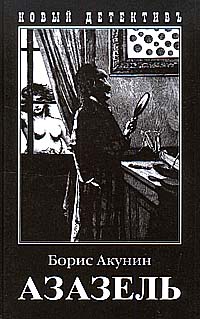
I’ve passed the halfway point of the set of detective novels by Boris Akunin, chronicling the adventures of the stuttering ratiocinator Erast Petrovich Fandorin in the waning years of the Russian monarchy, 1876–1905. This is another case of my discovering something that was already a smash hit. I stumbled across a couple of the Fandorin novels while Cover of Akunin's 'Azazel'browsing in an online Russian bookstore, and the quaintly antiquarian covers caught my eye. Then the description piqued my interest: the books are part of a “literary project” to present “all genres of the classical criminal novel.” For instance, the first book, Azazel, was a “conspiratorial detective story” (конспиративный детектив); the book I’m starting now, Coronation, is a “detective story of high society” (великосветский детектив). I guess I have a soft spot for that sort of encyclopedic ambition. After reading the first two, I decided I had to have the whole set.

Between two Russian bookstores in the US, I managed to find them all—except one. Drat! Then I discovered that Akunin has a website where all the novels can be read online for free. (Gee, was that my first hint that this Fandorin stuff was no secret?) So what did I do? I created a PDF of the missing novel out of the web pages! Must … have … complete … set … Must … have …

And that’s how I read Leviathan (which is the name of a ship): a PDF printout. But then—lo and behold—I somehow found a third bookstore that had Leviathan (the third novel in the series) in book form. Naturally I had to have it. As it turns out, the printed version had a surprise in store. Each chapter is presented in the voice of the various characters (all suspects in a multiple homicide). One of them is Japanese, and his chapters are printed sideways! The series abounds in typographic shenanigans, sometimes effective, sometimes maddening (some of the script fonts are almost unreadable).

Speaking of things Japanese (and this is going to be stream-of-consciousness, there’s no way around it), the next novel introduced a sidekick for Fandorin, a sturdy and steady Japanese fellow named Masa (short for Masahuro). Fandorin apparently found much to admire in Eastern culture during a short visit to Japan between books three and four; this and subsequent installments contain much interesting stuff about Japanese philosophy, weaponry, physical training, and so on. Fandorin and Masa work out together every day—occasionally the scene conjurs up the image of Inspector Clouseau being ambushed by Cato (or vice versa), but the Fandorin books never descend to slapstick.

And wouldn’t you know it? The author is a Japanologist! But his name isn’t B. Akunin—it’s Grigory Chkhartishvili, and he’s editor-in-chief of a 20-volume anthology of Japanese literature. For a time he worked as assistant to the editor-in-chief of the magazine Foreign Literature.

Did I say he’s kind of famous? In 2000 he was named Russian Writer of the Year. Three of his Fandorin books have been made into big-budget films (one of them starring Nikita Mikhalkov), and several have been translated into English and other languages. All this from Wikipedia, which also has a nice chunky article about the fictional Fandorin!

Having got this far in the series, I have to say the coverage of the genres doesn’t seem exhaustive, or even particularly comprehensive, and the stylistic differences between the books aren’t as great as one would suspect. But despite any marketing excesses, they’re great fun, and the combination of historical detailing and a modern sensibility is quite satisfying to this particular reader.

Posted in Russia | Tagged , | Leave a comment

Possibilities

This from Haaretz:

Just meters from the Brandenburg Gate, the 18th-century structure that came to symbolize Nazi power and was only reopened with Berlin’s reunification, stands one of city’s most beautiful and famous hotels, which is where the American Jewish Committee chose to celebrate its 100th anniversary. …

“It was important for us to send a message of the possibility of change and development,” AJC executive director David Harris said of the festivities in Berlin. “Who would have foreseen a half a century ago the way that German-Jewish relations have evolved. It seemed very improbable in the 1950s, so maybe something equally improbable will meet us for our 150th anniversary. Maybe it will be in Tehran, maybe it will be in Damascus, maybe it will be in Bejing, I don’t know. If Jews and Germans can get together in this very celebratory manner, then anything becomes possible.”

Later in the piece Harris mischaracterizes the recent article by Mearsheimer and Walt (Daniel Levy, an advisor to Ehud Barak, is more even-tempered and level-headed in his response), but it wasn’t enough to take the shine off his earlier sentiments.

Posted in Agora | Tagged , , | Leave a comment

Scumbag

Not going to name names. But did you know the word is incredibly vulgar? I sure didn’t, or I wouldn’t have put it up there as the title of this blog entry.

Now I’ll go back to eating my imaginary $12.95 rape salad and try to forget that I was gypped in my own mind (thank God this ain’t the New York Times).

Posted in Random | Tagged | 1 Comment

Tunes

Russia would very much like to join the World Trade Organization. Two countries currently stand in its way: The United States and Colombia. Well, one country, really. At least, that’s how President Putin sees it (as reported by Lenta.ru):

At the end of March Vladimir Putin, in his inimitable way, accused the US of artificially setting Russia back in discussions concerning its entry into the WTO. A few days later American officials, who could not remain indifferent to Putin’s declaration, published a long list of complaints against Russia.

In addition to Russian tariffs and trade barriers and other esoteric stuff (e.g., not allowing insurance companies and banks to set up affiliates in Russia), one complaint has to do with copyright infringement:

The US flatly says in the document that this is a key issue for the country’s entry into the WTO. According to trade experts, the United States loses as much as $1.7 billion annually as a result of illegal copying of music, videos, and software.

How much of that is happening in Russia, they don’t say. But it did make me wonder about a couple of Russian MP3 sites (AllOFMP3.com and MP3Search.Ru). One might assume they pay the copyright owners for each song downloaded, but how does one know? After all, we don’t really know that iTunes pays the artists for each download, do we? But we can reasonably assume Apple would get its butt sued off if it didn’t.

Back in the bad old days, the Soviet Union chose not to sign on to the Berne Convention, preferring the looser Universal Copyright Convention (which it signed on to in 1952). The new Russia signed on to Berne in 1995. The question is, does Russia actually protect foreign copyright holders? That is, do they allow foreign entities to litigate alleged infringement? If the US is raising a stink about it in the WTO talks, I would guess not.

The more local issue, of course, is: how much should Joe Consumer, law-abiding American, care? If he pays for an internet service he takes to be legitimate, is that enough? If not, how much research is he supposed to perform to legitimize the purchase of a handful of MP3s? AllOFMP3.com rewards the curious consumer with this (if you click on “Legal Info” and keep clicking):

Is it legal to download music from AllOFMP3.com?

The availability over the Internet of the ALLOFMP3.com materials is authorized by the license # LS-3М-05-03 of the Russian Multimedia and Internet Society (ROMS) and license # 006/3M-05 of the Rightholders Federation for Collective Copyright Management of Works Used Interactively (FAIR). In accordance to the licenses’ terms MediaServices pays license fees for all materials downloaded from the site subject to the Law of the Russian Federation “On Copyright and Related Rights”. All these materials are solely for personal use. Any further distribution, resale or broadcasting are prohibited.

The works available from ALLOFMP3.com are protected by the Law of the Russian Federation “On Copyright and Related Rights” and are for personal use of a buyer. Commercial use of such material is prohibited. Recording, copying, distribution on any media is possible only upon special consent of a Rightholder.

The user bears sole responsibility for any use and distribution of all materials received from AllOFMP3.com. This responsibility is dependent on the national legislation in each user’s country of residence. The Administration of AllOFMP3.com does not possess information on the laws of each particular country and is not responsible for the actions of foreign users.

Well, that certainly clears things up!

MP3Search.Ru has a similar notice, but includes a link to FAIR—in Russian, Федерация правообладателей по коллективному управлению Авторскими правами при использовании произведений в Интерактивном Режиме, hence the acronym. The FAIR home page includes a paragraph describing its dealings with foreign artists:

In accordance with the Law “On Copyright and Related Rights,” FAIR is obligated to act in the interests of all authors and rightholders, both Russian and foreign. FAIR acts under the authority of powers granted by the Law regardless of the existence or absence of a contract with each individual rightholder. …

It goes on to elaborate on the right of all rightholders (including those who have not entered into a contract with FAIR) to demand compensation for the distribution of their property. That’s a bit more comforting. I’m having a hard time picturing the process—who sets the rates of royalty payment and how; how rightholders are notified of the use of their works (or if they are); etc. Then again, I don’t know how ASCAP works. I think I’ve satisfied my curiosity for now.
Posted in Russia | Tagged , , , | Leave a comment

Schrödinger

Here in the Basement, we try to avoid two things:

  1. Simply pointing to posts at other blogs, no matter how good they are or how much we agree with them;
  2. Encouraging the importation and distorted application of complex scientific concepts to life, literature, or even other branches of science.

But this post brings quantum mechanics to bear on modern politics so perfectly, we couldn’t resist.

(Why do I say “we”? I don’t know—I keep feeling there’s someone else down here …)

Posted in Agora, Random | Tagged , , | 1 Comment

Really

Recently we were all treated to the spectacle of George W. Bush not answering a question put to him by Helen Thomas: “Why did you really want to go to war [in Iraq]?” Today the Independent reports that the US and UK are establishing “enduring bases” there. I can hear GWB divvying them up:  “Two for you and four for me …” We are supposed to believe the new bases are not a reason GWB went to war. We are suppposed to forget that, immediately after the invasion in the spring of 2003, the US military began its exodus from Saudia Arabia, where its presence was a major irritant. This past week Condoleezza Rice admitted the US has made thousands of mistakes in Iraq, but insisted the invasion was “the right strategic decision.”

Here’s what it sounds like to me:

Cop: “Where did you get that stuff?”
Not-a-burglar: “What stuff?”
Cop: “That stuff—in your hands.”
Not-a-burglar: “What, this stuff?”
Cop: “Yeah, that stuff! Jewelry, cash, classic PEZ dispensers …”
Not-a-burglar: “Oh, that stuff. I found it.”
Cop: “Found it. In that big fancy house there, right?”
Not-a-burglar: “Maybe.”
Cop: “Whaddya mean, maybe? You were in that house.”
Not-a-burglar: [Nods imperceptibly]
Cop: “What were you doing in there?”
Not-a-burglar: “I thought I heard someone calling for help.”
Cop: “You thought you heard someone calling for help!”
Not-a-burglar: “Yeah.”
Cop: “So you broke a window and crawled in.”
Not-a-burglar: “Yeah. What would you have done?”
Cop: “And you didn’t find anyone calling for help.”
Not-a-burglar: “Unfortunately, no.”
Cop: “Unfortunately no?!”
Not-a-burglar: “I mean, fortunately, no.”
Cop: “You were happy no one was there, calling for help.”
Not-a-burglar: “What, you wanted there to be a human tragedy?”
Cop: “So, you think this stuff is yours?”
Not-a-burglar: “Like I said, I found it.
Cop: “C’mon, pal, cut the crap. Why did you really want to go into that house?”

Etc.—the farce continues (for much too long).

Posted in Agora | Tagged , , | Leave a comment

Natural

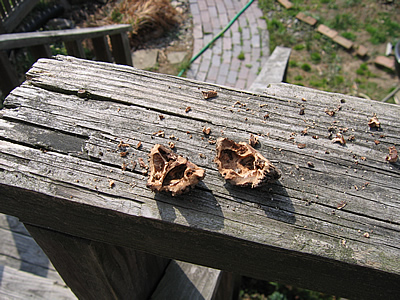
The neighborhood squirrels like to hide black walnuts in our yard. I’m not sure where the nearest black walnut tree even is. Today one of them left something behind on the deck railing after its breakfast—sort of a nature morte.

Walnut Shell Nature Morte

The critter’s got a good eye.

Posted in Random | Tagged , , | Leave a comment

Ones

Laura sent an e-mail to a mutual friend, letting him know about a Terry Jones show on TV this week, The Story of One.

Here’s what she got back:

Ah yes, one.
It’s given us all a lot of trouble.
First the Jews turned it into a religion.
Then the Christians showed up and kept calling it three.
The Manicheans—remember the Manicheans?—kept insisting that it was really two halves that never belonged together.
Then the Muslims came along and all we ever heard was One One One.
Dreary.
With the Middle Ages things calmed down.
We kept our one faith over here, they kept their one faith over there.
Lots of ones but it seemed okay as long as we built high walls.
But after Mr. Fibbonaci came back from India with the zero, one never recovered.

Have you?

—from “From Zero to Ten in Five Theologies,” by
Msgr. Ambrose Poppensweet, S.S.R., L.L.T., P.G., and R.

 The dude’s got blogging potential, doncha think?

Posted in Random | Tagged , , , | Leave a comment

Remorse

My buddy over at Newsrack Blog has an interesting post on regrets from folks who initially supported the Iraq invasion (including himself). I give them all a lot of credit. It’s not easy to admit a mistake.

But what mistake is it? Doing it, or not doing it right? Some of us continue to occupy a minuscule spit of land in the American political landscape: we opposed the impending Iraq invasion even if it might turn out to be successful (or should I say, especially if it were successful). Even if the US army had found evidence of a nuclear weapons program (which we doubted existed—why didn’t more “experts” call Saddam’s bluff?); even if the population had embraced the invaders as liberators and immediately formed a House of Representatives and a Senate (with two [virtually indistinguishable] parties and two parties only) and a Department of Health and Human Services and a Baghdad Chamber of Commerce and a Fox News Network etc.; even if the US ended up with military bases in a new, friendlier Iraq in order to project its democracy-building power in the rest of the region; even if a lot of supposedly good things came out of it—we would have been against the invasion. Especially if all those things came to pass. This sort of success in Iraq, a reward for invasion, would have harmed the United States—would have corroded its soul and besmirched its former ideals—more than its current failure.

This is not to say the failure in Iraq makes us happy. This is not to say we’re certain we were right to think what we thought then (and still think now). Maybe the imperial theorists have it right. Maybe we’re naive. But we certainly are sad about what we (the larger American e pluribus unum we) have done and what we have become, and disappointed that we (back to the little we) couldn’t prevent it. Maybe, amid the destruction and self-destruction, we’ve “done some good” in Iraq, as unrepentant war supporters insist; but what a way to do it. What a way to do good.

Posted in Agora | Tagged , , | 4 Comments

Basking

It’s so nice to stumble on some good news. I think I’ll sit back and enjoy it …

While I’m at it, I’ll let a bloggy smile turn into a good laugh (“stuart”’s comment)—as long as I don’t tip my chair back too far and end up on the floor.

Posted in Agora | Tagged , , , | Leave a comment