Zvuki Mu

This morning I had a simple, nostalgic little thought: What ever happened to Звуки Му?

Well, with the internet at my fingertips, it didn’t take long to discover that, far from going up in smoke as a flash in the perestroika pan some time in the nineties, Звуки Му is alive and kicking. That is to say, Pyotr Mamonov is, because that’s what Звуки Му is. (I should have listened to my Moscow friend Petya B., who claimed to know Mamonov personally and declared that ЗМ = ПМ.)

His first album (at least, I think it was his first — it’s listed that way at his website) was godfathered by Brian Eno. It started off in quintessential Mamonov style:

Муха источник заразы
Сказал мне один чувак
Муха источник заразы
Не верь—это не так
Источник заразы—это ты

That is to say:

The fly is the source of infection
Some guy told me a while ago
The fly is the source of infection
Don’t believe it—it just ain’t so
The source of infection is you

The album count is currently at 23, so clearly Звуки Му/Петр Мамонов has been up to something since our first acquaintance (via vinyl) in 1989.* In addition to his CDs (where the number of accompanists has apparently dwindled past minimalist), Mamonov has done theater and film work (I guess I’ll have to see Anna Karamazova).** This review from a Russian online music magazine makes one want to catch up with this wonderful maniac (maybe I’ll translate some of it if I get a chance).

So the question isn’t: what happened to Zvuki Mu? It’s: where the hell have I been?
__________
*Some local Russophiles and I were lucky enough to see ЗМ/ПМ at the 9:30 club in Washington—must’ve been 1990 or ’91.
**And he had a major role in Taxi Blues—how could I have forgotten that?

Posted in Russia | Tagged , | 1 Comment

Konchalovsky

Last year the acclaimed Polish actor Daniel Olbrichsky turned sixty, and the mayor of Warsaw gave him a present he still hasn’t gotten over: he could pick any theater, any play, any actors, any director, Olbrichsky would play the lead, and the city would cover all expenses.

Olbrichsky asked Andrey Konchalovsky to direct, and together they chose King Lear.

What follows is a translation of an interview with Konchalovsky that appeared in Московские новости on 2 February 2006.

The Moscow News correspondent [Valery Masterov] asked how long Konchalovsky mulled over the offer from Olbrichsky.

Andrey Konchalovsky—I agreed immediately. First of all, Daniel is a huge actor on stage and screen. I hadn’t had a chance to work with him, and I didn’t want to miss this opportunity. Second, right now I’m drawn more to theater, especially the classics.
—So you took the commission without any doubts?

—There were some doubts about which play to choose. We thought about Chekhov, Strindberg, Ibsen. But we preferred Shakespeare, who was the first I’d ever directed. King Lear is a very difficult piece, and I thought: If not now, when?

—You’ve said many times that traditional culture is dying and that, in this context, the classics look absurd. And yet you chose a classic.

—When I speak of the assault of postmodernism, it’s Europe I primarily have in mind.

Nowadays they present the classics in abundance, but transfer the action to different places and times. Fashionable directors want to attract attention to themselves — the author of the play is, for them, a pretext for self-expression.

—In the Polish press they wrote that the leitmotif of this Shakespeare play—the rejection of absolute power and the collapse of the monarchy—can be seen as the disintegration of the Soviet empire.

—People can write whatever they like. You want hints? Look for them. It’s people living under totalitarian regimes who go to the theater to find hidden political references.

What my Lear is about I’ll venture to say after the tenth performance, at the earliest. I tried to understand what the author was trying to say. Shakespeare wasn’t answering questions, he was asking them. And so the viewers will ask themselves questions, which, after a good performance, basically reduce to a question about life: What does it all mean?

—How much time did you spend preparing for this production?

—I started preparing for it forty-five years ago. Work on any production consists of everything you’ve done previously. And the experience of King Lear will undoubtedly enter into preparation for the next production.

—What was your working relationship with the Polish actors? You’ve said there’s a curtain between Russia and Poland, dividing our culture, mentality, religion …

—And the curtain will always be there. Just as between, say, Russian and Estonia. In Moscow there are loads of theaters, one and the same culture, but the rancor is indescribable.

It’s possible for people to belong to the same culture and detest one another, but it’s possible to present different cultures and love one another if you work together on the same task.

—You weren’t bothered by the fact that the actors were taken from popular Polish television series?

—Daniel handled the casting. The actor must be good, first and foremost. And good actors earn money, unfortunately, in various ways. You can’t make a living in the theater, even playing Shakespeare.

—But people who are used to TV shows will come to see familiar actors, not Shakespeare.

—The main thing is that they come and that they think.

Posted in Russia | Tagged , | 1 Comment

Ratings

Two Soviet-era literary giants went head-to-head on Russian television and battled to a draw. The miniseries based on Aleksander Solzhenitsyn’s The First Circle drew about the same number of viewers as The Golden Calf, based on a work by the humorists Ilf and Petrov. However, both were beaten handily by Mikhail Bulgakov’s Master and Margarita, which ran a while back.

It seems history has overtaken Solzhenitsyn. He was the calf who butted an oak (see the title of his nonfiction account Бодался теленок с дубом), but it turned out the tree was rotten and went down too easily.

As Igor Mitin wrote in Literaturnaya Gazeta,* after noting that В круге первом was begun in 1955, was distributed in a “distorted” version in 1964, and found its final form in 1968:

One needs to know these dates in order to realize that the novel was conceived and written at a time when the Soviet system and the Soviet state seemed absolutely powerful and unshakeable. As the director of the film, Gleb Panfilov, admitted, when he read the novel for the first time he thought it might be possible to transfer it to the screen in 300 years, perhaps … That is, in dealing with such an invincible and hopeless hulk, it was possible in one’s unmasking hatred to not match its power and reach, not think of the consequences, since it would take a hundred years for them to appear.

But life, as usual, delivered a surprise to all the prophets, and now we live in completely different times. The Soviet totalitarian machine, created and fine-tuned by Stalin, has been ancient history for some time now. And this invariably alters and corrects the way we now perceive both the book and film.

Here’s just one citation from the novel:

“And so I’m sick of both Ostrovsky and Gorky because I’m sick of how they expose the power of capital, family oppression, the old marrying the young. I’m sick of these battles with ghosts. Fifty years have gone by, a hundred, and we’re still flapping our arms, still exposing what’s long gone. And as for what actually exists—you won’t see any plays about that.”

The mole of history roars continuously. And now the power of capital is no longer the distant past but the harsh present, and Solzhenitsyn himself speaks of it with dread and pain. So how do we now assess the behavior of Innokenty Volodin, who decided to try and impede the development of the atomic bomb in the Soviet Union? That is, impede the creation of the parity in the world that helped preserve peace for years and years? Today we know very well what the self-confident and self-satisfied superpower America has turned into—bombing Serbia, occupying Afghanistan, making war in Iraq …

Likewise, you won’t surprise us nowadays with the standard, caricatured protrayal of Stalin and his henchmen, the details of zek life and manners that pounded at our brains and our imagination when we read the novel for the first time. Today, when every film has heroes that talk like they’ve been in prison [когда у нас что ни фильм, то зона, когда все герои только и делают, что «ботают по фене»*], the stuff has lost its effect.

So the film’s creators and, especially, the director faced some serious dangers: to be gripped by what is widely known, has been said many times. But Panfilov being Panfilov, he knows that no ideology, trend, tendentiousness, no details of the time can save you without great artistry. Only art is capable of breaking the circle of problems of that time and expose what is necessary and important in them for those living today.

And only then will the contemporary audience understand that what they’re seeing is not a battle with ghosts, not the exposure of what disappeared long ago, but of that which is. The first installments of The First Circle lead one to hope that this is the case.

__________
*Broken links replaced 2007.07.30. Links broken again as of 2018.05.25—cannot track down Mitin’s review at LitGazeta.

Posted in Russia | Tagged , , | 2 Comments

Cold

While much of North America basks in unseasonably warm temperatures, Russia is enduring one of the coldest winters on record.

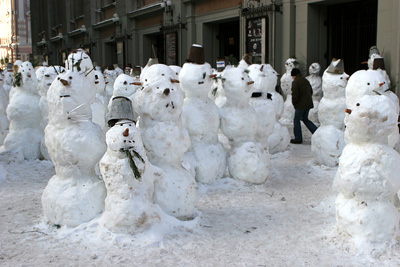
As usual, Russians are doing more than coping. In Moscow, snowmen appeared in the Arbat and thousands protested against nationalism.

Snowmen in the Arbat

Photo by Nicholas Danilov, MosNews.com

Meanwhile, Boris Yeltsin says he has no regrets in naming Vladimir Putin to succeed him. But this little exchange seemed to come from left field:

By the way, what do you think about Lenin’s body remaining in the Mausoleum on Red Square?

I did not have the time to finish the whole story with Lenin’s reburial. We should have buried his body long ago, like good Christians.

In honor of Yeltsin’s 75th birthday (Feb. 1), Московские новости is running excerpts from a new biography by Vitaly Tretyakov.

Posted in Russia | Tagged , | Leave a comment

Basement

It suddenly dawned on me that WorldWideWeber is not an appropriate name for this blog. After tossing around a few alternatives, I’ve settled on Notes from the Basement.

It should be apparent that this is an homage à Dostoïevski,* a nod to his Записки из подполья, usually rendered in English as Notes from Underground (or even less faithfully as Notes from the Underground). Some commentators have offered alternative renderings of подполье, without going to far as to recommend its use in the translated title. For instance, some have noted that the word literally means “under the floor,” and have suggested that Dostoevsky meant to conjure the image “beneath the floorboards” (especially since his “hero” likens himself to a mouse at one point).

Naturally at moments like this one turns to V.I. Dahl [Даль], the great Russian lexicographer. He defines подполье as “простор или яма под полом; у крест. это род чулана или погребка, либо с западней, либо с ходом через голбец” [a space or hole under the floor; among peasants it is a sort of larder or cellar with either a trapdoor or an entry through a storeroom].

So it seems “cellar” would be the most accurate translation. However, for my purposes it sounds too rustic. (I think of Dorothy struggling to get the door to the cellar open as the tornado bears down on her.) It also makes me think of “notes from the seller.” (Doesn’t everyone think homonymically?)

So “basement” it is, connoting dim light, cobwebs, and perhaps even a mouse or two; a place where a guy can retreat and type a few words into the æther.

This new title should also signal a desire on my part to open a new area of the blog and begin tracking contemporary Russian life.

_____________
*Isn’t that exquisitely pretentious? I couldn’t help myself—I find Dostoevsky’s name such a stitch in French.

Posted in Random | Tagged , | 1 Comment

Slippage

Well, another month has all but slipped away. Make that: another year. My year, that is—the reckoning that began when I stuck my head out of my mother’s belly and thought: “Crap, it’s bright out here!” Moments later, a new thought: “Crap, it’s cold, too!”

Actually, the story goes that I had to be dragged out. “Forceps …” (Is that Dr. Kildare? or Dr. Chamberlen?) Grab that greasy little thing!

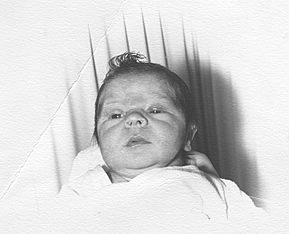
My siblings all have nice first-day photos from the nursery at Rainbow Babies and Children’s Hospital in Cleveland: my older brother sleeping soundly, the younger ones just staring vacantly or dozing. My first portrait is a standing joke in the family: eyes glaring at the stupid camera guy, one eyelid puffy like a prizefighter’s, the head slightly lopsided … What a way to start a life!

A product of forceps circa 1954

(Nice pompadour, or whatever it is you call that flip up top.)

Now everything’s just fine—haven’t seen a forceps since.

Corrigendum 2009.10.07: I’ve been meaning to make this correction for some time now. It turns out my older brother and I were born at St. Ann Hospital, not Rainbow Babies and Children’s Hospital, where the rest of the gang was born.

Posted in Random | Tagged , , , , | Leave a comment

Concision

It’s true: I try to be concise. Sometimes this has worked out well. For instance, a favorite professor once wrote on a paper of mine: “Short, sweet, to the point.” On the other hand, my current boss continually presses me to flesh out what he calls my “orphic utterances.”

Well, here’s what Marianne Moore had to say.

To a Snail

If “compression is the first grace of style,”
you have it. Contractility is a virtue
as modesty is a virtue.
It is not the acquisition of any one thing
that is able to adorn,
or the incidental quality that occurs
as a concomitant of something well said,
that we value in style,
but the principle that is hid:
in the absence of feet, “a method of conclusions”;
“a knowledge of principles,”
in the curious phenomenon of your occipital horn.

Posted in Random | Tagged , | 3 Comments

Privacy

Leave aside the Bush administration’s abuses that have captured our attention recently. It turns out anyone can get ahold of your phone records—and at a pretty affordable price, too. (Kos has more here).

Posted in Agora | Tagged , , | 1 Comment

Unread

Here’s a sig that resonates:

In the future, everyone will have a blog, and none of them will be read. My unread blog will be Symmachus.

(Found it over at Daily Kos—a phenomenally widely read blog.)

Posted in Random | Tagged | Leave a comment

Emptiness

The home renovation is just about done. It’s incredible how the crumbling plaster and decayed bathroom vanity have disappeared from my memory. Looking at the fresh paint and new fixtures, it’s as if they’ve always been there. I have to work to remember how crappy it all looked.

All that’s left is to remove the incredibly fine dust that has settled on all horizontal surfaces and move everything back in its place.

Everything? Maybe not.

It almost seems a shame to hang the pictures again—the rooms looks so nice with nothing on the walls. Who needs a mirror in the bedroom? Maybe we should get rid of most of these books …

Whoa! Okay, we keep the books (most of them). But this attractive emptiness reminds me of Laura’s dream house. As she describes it, there would be one room with absolutely nothing in it. You’d go in there to empty your head. What a luxury that would be. Some would say it sounds like solitary confinement—the “hole,” as they say. Well, what’s the purpose of the hole if not to focus the prisoner’s thoughts on what’s really important? We should all toss ourselves into the hole from time to time.

Posted in Random | Tagged , , | 3 Comments