Photos by Vanderlin
“Looks like a bomb t’me. Whaddya think, Mick?”
“Yuh, could be. Better blow id up just in case.”
Photos by Vanderlin
“Looks like a bomb t’me. Whaddya think, Mick?”
“Yuh, could be. Better blow id up just in case.”
It’s progress of sorts. Both the New York Times and the Washington Post described how “tens of thousands” marched in Washington on Saturday in protest against the Iraq war. In September 2005, an even bigger march was characterized by the Times as “thousands” of protesters. Technically true, but oh-so-misleading. The coverage—scant and dismissive—provoked a massive protest of its own, and within days the Times published a better, truer version of the event. This time both newspapers devoted a reasonable amount of space to the rally and march, and the tone was properly neutral. It’s amazing what three years of disaster in Iraq, a sea-change election, and a populace that has found other channels of information can do to mainstream reporting. The press duly noted that the march was large enough to loop back on itself—when those at the front reached the end of the march route (which started on the Mall and wound past the Capitol on the east side), they came upon marchers just beginning the trek.
As usual, creativity of all sorts was on display, from clever signs to costumed performers. I offer just a few scenes that struck my fancy. You can find more photos in the Washington Post story.
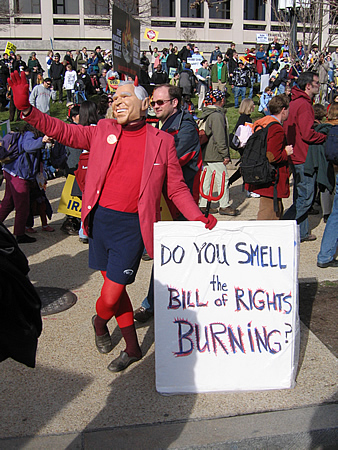
George W. Bush’s buddy, the attorney general, says “[t]here is no express grant of habeas in the Constitution.” No, just an express injunction that it is not to be suspended except in the case of rebellion or invasion. Probably everyone at Saturday’s protest knows that the right wasn’t explicitly stated because it was assumed as part of our legacy of British common law—it is a given. I wonder why the nation’s top lawyer acts as if he doesn’t understand that?
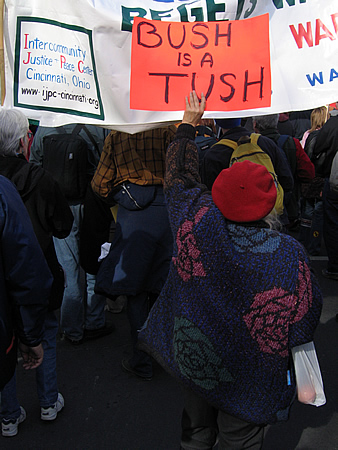
This lady was about 4′10″ and had the bad luck to be right behind a big banner (and probably in front of one as well). I had the feeling she was too nice a person to use spicier language, which wasn’t hard to find—for instance … Continue reading
It should come as no surprise that composers of music for motion pictures continually mine the classical repertoire, just as contemporary novelists grab whatever they can from the stocks of literature, ancient and modern. (Have you heard the story, for instance, of “a cultivated man of middle age [who] looks back on the story of an amour fou, one beginning when, traveling abroad, he takes a room as a lodger. The moment he sees the daughter of the house, he is lost. She is a preteen, whose charms instantly enslave him. Heedless of her age, he becomes intimate with her. In the end she dies, and the narrator—marked by her forever—remains alone.” The story was published in 1916; its author is Heinz von Lichberg. Not the story you were thinking of, is it? It was, however, called “Lolita.” All this courtesy of an article by Jonathan Lethem in the February 2007 Harper’s, “The Ecstasy of Influence.”)
Today’s musical tidbits revolve around the Hitchcock classic Psycho. Anyone who’s seen it cannot help but be struck by the soundtrack, composed by the acclaimed Bernard Hermann. As Wikipedia notes, “The screeching violin music heard during the famous shower scene (which Hitchcock originally suggested have no music at all) is one of the most famous moments from all film scores.” Here’s what it sounds like, in case you’ve forgotten:
Now here’s a snippet from a piece composed some forty years earlier:
I think it’s unlikely Hermann would have been unaware of Prokofiev’s Violin Concerto No. 1, which has enjoyed enormous popularity over the years. (The clip above features Berl Senofsky with the Cleveland Orchestra under George Szell; my best guess is that this radio broadcast dates from the late fifties or early sixties.) Hermann’s music is quite different, both in its relentless repetition and the palette of accompanying notes. And yet one can’t help but feel he must have been inspired, consciously or not, by the Prokofiev. (If unconsciously, it would be a case of cryptomnesia—another tip of the hat to Jonathan Lethem.)
For the technically curious, I offer this Q&A about the actual notes used in the Psycho excerpt:
Q: What are the notes or note being played during “The Murder” in the famous shower scene (the violin shrieks)? (from Mr. Bunderfull in Chicago Ill. U.S.A.)
A: The highest note in the violins is an E flat, but the second violins are playing an E natural, and lower voices are playing F and G flat. So basically, the highest note is E flat, but everything from E flat to G flat is being heard. (thanks to Gizm, Texas)
If you like this sort of thing, here’s something similar.
I’m going to go ahead and swipe this right out of Harper’s. First of all, it’s the lazy thing to do. Second, they swiped it from the Chicago Manual of Style Online—specifically the section that’s a sort of “Dear Abby” for copyeditors. I happen to have been one, and like they say,* once a copyeditor, always a coypeditor. (Never did like proofreading, though.) And I also “learn[ed] English grammar from the nuns.” So I find this stuff riproaringly funny.
Q. When I began learning English grammar from the nuns in 1951, I was taught never to use a comma either before or after independent clauses or compound sentences. Did the rules of English grammar and punctuation change while I was in that three-week coma in 1965, or in the years that it took to regain my basic and intellectual functioning before I returned to teaching?
A. I’m sorry, I can’t account for your state of mind, but standard punctuation calls for a comma before a conjunction that joins two independent clauses unless the clauses are very short. I would go further and suggest that it’s a good idea to reexamine any rule you were taught that includes the word “never” or “always.”
Q. Is there an acceptable way to form the possessive of words such as Macy’s and Sotheby’s? Sometimes rewording to avoid the possessive results in less felicitous writing.
A. Less felicitous than “Sotheby’s’s”? I don’t think so.
__________
*Do not bother to tell me it should be “as they say.” Tell me anything else, but not that. Continue reading
I don’t usually go in for pictures of sunsets. But the one last night seemed unusual, so I took a few pictures. If I had been serious about it, I would’ve used a tripod. As it turned out, most were blurry, as I adjusted the exposure downward and paradoxically ended up with a shutter speed of 1/6 s. One striking aspect of the sunset was the extent to which it blanketed the western sky. Also interesting were the gashes in the clouds—white luminous transient gaps in the slowly roiling waves. And the little dark scraps scudding by at a lower altitude.
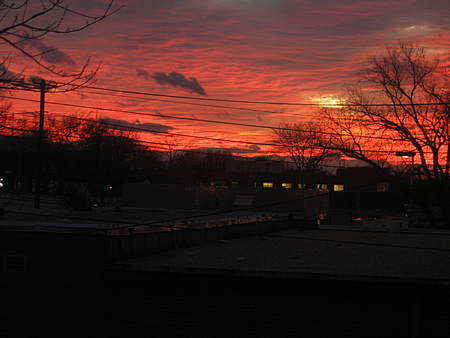
On a nonvisual level, those who saw it were probably thinking of the previous day, when the temperature reached near 70°F, in contrast to the blustery conditions that followed—appropriate to the season, at long last. The sunset seemed to say: Wake up! It’s winter!
John Aravosis over at AMERICAblog took note as well. His photo is rather more dramatic, but I wonder whether he intensified it after the fact.* In any case, it was quite something—for DC, anyway. There’s seems to be something about our weather patterns, or something in our air, that makes flamboyant sunsets a rarity.
__________
*In the comments, he says he did not. That leaves other technical explanations for his deeper reds—different metering choices, different sensors, different image processing by the camera, etc.—in addition to ambient differences (location, time, etc.).
According to this entry from a while back, my four favorite dishes are spaghetti, leftover spaghetti, spaghetti memories, and spaghetti dreams. I now realize that the third item should have been “klobasa memories”—specifically, memories of the kranjska klobasa made by my grandfather. There are shops on the east side of Cleveland that still make Slovenian sausage, and it’s pretty darn good. My mom makes sure it’s served every Christmas and Easter, or other times when her far-flung children visit. But we all know—it’s not as good as grandpa’s was.
This second-best klobasa recently made the news when an astronaut took some up to the International Space Station* (along with some Euclid Beach popcorn balls—but that’s a whole ‘nother story, involving my dad’s side of the family). It turns out the astronaut’s mother is Slovenian, and not just—her maiden name is the same as my mom’s.
Anyway, I knew at the time I was being flip and a little lazy about the food question. I should’ve mentioned my mother-in-law’s soup with manti (little meat dumplings). And the list of four couldn’t accommodate the dishes concocted by my dear wife—for instance, the fennel pasta, the potato and leek soup, the “Ursy caserole,” the pizza rustica (a double-crusted “pie” in the traditional sense), her variation of Ming Tsai‘s fried rice ….
Makes you wonder how often I’m flip and lazy, doesn’t it? Well, keep wondering. (Or not.)
__________
*Correction (2007.01.15): Upon further review, the delicacy carted up to the space station was a package of Azman’s “smokies,” not the traditional (in my view, anyway) Slovenian sausage (which could not, by any stretch, be characterized as “thin”). Also, why give all the publicity to Azman’s? Some folks get their klobasa from Radell’s.
On December 31, I thought about resolving to be even lazier in 2007 than I was in 2006, but I never got around to it.
Why I like the New York Times (and New York):
The last New York City mechanical parking meter—an emblem of street life, an object of motorist frustration and endless source of fascination for city children since 1951—was withdrawn from service at 10:25 a.m. today.
The last mechanical parking meter was removed from its location in Coney Island today.
The demise of the mechanical meter was painless but not swift. Since 1995, when the city first tested battery-powered digital meters and quickly found them to be more accurate, reliable and vandal-proof than the older spring-loaded devices, the days of the mechanical meter have been numbered.
By the start of this year, the mechanical models made up only 2,000 of the 62,000 single-space meters in the city. This morning, in a somber but unpretentious ceremony on the southwest corner of West 10th Street and Surf Avenue in Coney Island, Brooklyn, the very last one was retired.
Fifteen officials from the Parking Operations Bureau of the City Department of Transportation came to watch as the last mechanical meter was removed from its iron casing and replaced with a digital one. (The new and old meters both fit the same casing.)
“… in a somber but unpretentious ceremony …” Lovely!
I’ve been holding off commenting on the Litvinenko case, because … well, because I can’t make heads or tails of it. As international mysteries go, this one is particularly murky. But that doesn’t keep the preternaturally astute Charles Krauthammer from sharing his indisputable conclusion that Vladimir Putin did it. Fresh from his astounding success at predicting the outcome of the US invasion of Iraq and other remarkable acts of prescience, the Mad Doctor expects to convince his reader (there must be at least one) that he knows everything there is to know about both the Kremlin and the Russian underworld.
I don’t pretend to know as much as CK, but here’s what I think is probably true:
Now, many observers take this last fact and spin a comely tale: Putin killed Litvinenko because he was a pesky critic. On second glance, it’s not such a well-written story. In fact, it just doesn’t make sense. Dr. Krauthammer talks of “Occam’s razor.” What a genius to think of using such a classic philosophical tool! But is this where Occam’s razor gets him? God help him when he shaves.
As luck would have it, on the very day the doctor reported his brilliant deduction, the Washington Post ran the first story I’d seen opening up the speculation to … well, who else but Platon Elenin (the fugitive in plain view formerly known as Boris Berezovsky)?
Do I know how polonium-210 ended up inside Alexander Litvinenko, and why? Of course not. Every day brings a new suspect or two (most recently, the colorful Dmitry Kovtun), who together with such early favorites as Andrey Lugovoy and the Italian Mario Scaramella (by some accounts a scheming scamp with a tenuous grasp of what some of us still quaintly call the truth) continue to lead us on a merry chase through the sewers of the world’s capitals.
Oh—and I apologize if the heavy dose of Krauthammer-induced sarcasm has corroded anyone’s monitors or LCD screens.
Addendum 2006.12.12: Katrina vanden Heuvel does a nice job cataloging the irresponsible, sensationalist coverage of the Litvinenko affair, especially in Great Britain. She also mentions the eminently reasonable alternative hypothesis put forward by Edward Jay Epstein, among others: that the polonium-210 poisoning may have been an accident, not murder, and the context might be smuggling, not political intrigue.
__________
*Lots of nice Russians ended up here as well—don’t get me wrong.
Gore Vidal was on Tavis Smiley the other night. He was as sharp and funny as always, especially on matters political and historical. True to his stage in life, though, a good chunk of the conversation danced with the notion—no, not the notion, the fact—of mortality. At one point Vidal quoted the last two lines of a poem by Gerard Manley Hopkins. He mischaracterized the context (saying the poem had to do with a child who had died), but he can certainly be forgiven for that. I happened to notice because the poem made a big impression on me many years ago—it’s the first four lines that periodically float into my mind (along with the last and the tail end of the penultimate). It being fall here in the northern hemisphere, the words came unbidden once again, even before I saw the autumnal Vidal on TV.
Spring and Fall:
to a young child
Márgarét, áre you grieving
Over Goldengrove unleaving?
Leáves, líke the things of man, you
With your fresh thoughts care for, can you?
Áh, ás the heart grows older
It will come to such sights colder
By and by, nor spare a sigh
Though worlds of wanwood leafmeal lie;
And yet you will weep and know why.
Now no matter, child, the name:
Sórrow’s spríngs áre the same.
Nor mouth had, no nor mind, expressed
What heart heard of, ghost guessed:
It ís the blight man was born for,
It is Margaret you mourn for.
The accent marks have to do with Hopkins’s concept of “sprung rhythm.” I didn’t understand it then, and I don’t understand it now. But you don’t need to understand sprung rhythm to love his poems.
