Felicitaciones

Congratulations, Gabrielle and Alejandro! (The rest of you—beat it!)

Posted in Random | Tagged | Leave a comment

Apostasy

Last week two prominent Republicans spoke at the Democratic National Convention, eloquently explaining why they will be supporting the Democratic ticket this fall.

Former US congressman Jim Leach of Iowa said “it is clear to all Americans that something is out of kilter in our great republic,” and went on to describe four “great debates” in our nation’s history, showing how both Democrats and Republicans made positive contributions to them. “In troubled times,” Leach said, “it was understood that country comes before party, that in perilous moments mutual concern for the national interest must be the only factor in political judgments. This does not mean that debate within and between the political parties should not be vibrant. Yet what frustrates so many citizens is the lack of bipartisanship in Washington and the way today’s Republican Party has broken with its conservative heritage.”

The devoted reader of these notes may recall a post from March of this year that took conservatives to task for allowing the Republican Party to become a radical force serving special interests, undermining the Constitution, and poisoning the political atmosphere in this country. I cited a few bright exceptions—specifically, several who support the impeachment of Bush and Cheney. Whether or not Leach supports impeachment, he is clearly one of the moderate Republicans I recall fondly from my youth and who seem to have become extinct in post-Reagan America.

Leach went on to make his case for change in November:

The party that once emphasized individual rights has gravitated in recent years toward regulating values. The party of military responsibility has taken us to war with a country that did not attack us. The party that formerly led the world in arms control has moved to undercut treaties crucial to the defense of the earth. The party that prides itself on conservation has abdicated its responsibilities in the face of global warming. And the party historically anchored in fiscal restraint has nearly doubled the national debt, squandering our precious resources in an undisciplined and unprecedented effort to finance a war with tax cuts.

America has seldom faced more critical choices: whether we should maintain an occupational force for decades in a country and region that resents western intervention or elect a leader who, in a carefully structured way, will bring our troops home from Iraq as the heroes they are. Whether it is wise to continue to project power largely alone with flickering support around the world or elect a leader who will follow the model of General Eisenhower and this president’s father and lead in concert with allies.

Whether it is prudent to borrow from future generations to pay for today’s reckless fiscal policies or elect a leader who will shore up our budgets and return to a strong dollar. Whether it is preferable to continue the policies that have weakened our position in the world, deepened our debt and widened social divisions or elect a leader who will emulate John F. Kennedy and relight a lamp of fairness at home and reassert an energizing mix of realism and idealism abroad.

The portfolio of challenges passed on to the next president will be as daunting as any since the Great Depression and World War II. This is not a time for politics as usual or for run-of-the-mill politicians. Little is riskier to the national interest than more of the same. America needs new ideas, new energy and a new generation of leadership.

Hence, I stand before you proud of my party’s contributions to American history but, as a citizen, proud as well of the good judgment of good people in this good party, in nominating a transcending candidate, an individual whom I am convinced will recapture the American dream and be a truly great president: the senator from Abraham Lincoln’s state—Barack Obama.

The other Republican who spoke last week at the Democratic convention is actually now a former Republican, and not just any Republican: it’s Susan Eisenhower, granddaughter of Dwight D. Eisenhower. A few days before her speech, she explained her decision to leave the Republican Party:

I have decided I can no longer be a registered Republican. For the first time in my life I announced my support for a Democratic candidate for the presidency, in February of this year. This was not an endorsement of the Democratic platform, nor was it a slap in the face to the Republican Party. It was an expression of support specifically for Senator Barack Obama. I had always intended to go back to party ranks after the election and work with my many dedicated friends and colleagues to help reshape the GOP, especially in the foreign-policy arena. But I now know I will be more effective focusing on our national and international problems than I will be in trying to reinvigorate a political organization that has already consumed nearly all of its moderate “seed corn.”  And now, as the party threatens to trivialize what promised to be a serious debate on our future direction, it will alienate many young people who might have come into party ranks.

My decision came at the end of last week when it was demonstrated to the nation that McCain and this Bush White House have learned little in the last five years. They mishandled what became a crisis in the Caucasus, and this has undermined U.S. national security. At the same time, the McCain camp appears to be comfortable with running an unworthy Karl Rove–style political campaign. Will the McCain operation, and its sponsors, do anything to win?

Eisenhower explained why she switched her party affiliation to “independent”:

As an independent I want to be free of the constraints and burdens that have come with trying to make my own views explainable in the context of today’s party. Hijacked by a relatively small few, the GOP of today bears no resemblance to Lincoln, Roosevelt or Eisenhower’s party, or many of the other Republican administrations that came after. In my grandparents’ time, the thrust of the party was rooted in: a respect for the constitution; the defense of civil liberties; a commitment to fiscal responsibility; the pursuit and stewardship of America’s interests abroad; the use of multilateral international engagement and “soft power”; the advancement of civil rights; investment in infrastructure; environmental stewardship; the promotion of science and its discoveries; and a philosophical approach focused squarely on the future.

The decision was not an easy one, “since politics, like religion, is something learned on the knee of one’s parents and grandparents.” But there will be some joy in her new status, since she will be able to speak for herself, and “not as a member of a party that has, sadly, lost its way.”

Eisenhower mentioned Rove—here’s an update on the Rovian legacy in John McCain’s campaign, giving a sense of how nasty things will probably get. Part of me wants to go to sleep for two months and wake up on November 5 with Barack Obama the elected president. But most of me wants to be ready to dive in when the rumble really starts.

Posted in Agora | Tagged , | Leave a comment

Bioduress

Just as a neighbor and I began talking seriously about putting up a bat house to attract these amazing mosquito-eating creatures to our mosquito-infested backyards, we learn that, like the honey bee, the bat is in trouble. It may not be for the same reason(s), but it’s disturbing nonetheless:

“This is the worst crisis I’ve ever seen,” says Merlin Tuttle, founder and president of Bat Conservation International. “I think anytime you have animals as ecologically essential, and as distantly related, as bees and bats dying en masse, it should send a canary-in-the-coal-mine signal.”

We look to science for answers, but if you listen to Scott Darling, a biologist with the Vermont Fish and Wildlife Department, science has been asleep at the wheel:

Cracking the mystery is proving particularly challenging because scientists know so little about healthy bats. “We haven’t known much about basic bat biology before this,” Darling says. “That is science’s little secret: We really don’t know a lot of what people think we know, or what people think we should know.”

One might worry that we’re seeing the beginning of a long and ultimately anthropocidal cascade of ecological disasters—ever accelerating species loss with ever expanding and cross-amplifying ripple effects. The overarching question is: Are we screwing up this place, or is all this “nature’s way” and it just looks bad to us because … because … well, because we’re so special?

Addendum 2008.08.02: Another canary in the mineshaft: jellyfish. Not that it means anything, but at the Outer Banks a couple of weeks ago I experienced a stinging sensation on my thigh after I’d come back from the beach. Eventually I discovered a little glob of sticky black goo in the pocket of my trunks. A piece of jellyfish. There were a few days when the kids reported a jellyfish problem, but this has happened just about every year we’re down there, and the jelly-in-the-trunks trick could’ve happened any time. The Times article is worrisome, though:

From Spain to New York, to Australia, Japan and Hawaii, jellyfish are becoming more numerous and more widespread, and they are showing up in places where they have rarely been seen before, scientists say. The faceless marauders are stinging children blithely bathing on summer vacations, forcing beaches to close and clogging fishing nets.

But while jellyfish invasions are a nuisance to tourists and a hardship to fishermen, for scientists they are a source of more profound alarm, a signal of the declining health of the world’s oceans.

“These jellyfish near shore are a message the sea is sending us saying, ‘Look how badly you are treating me,'” said Dr. Josep-María Gili, a leading jellyfish expert, who has studied them at the Institute of Marine Sciences of the Spanish National Research Council in Barcelona for more than 20 years.

The explosion of jellyfish populations, scientists say, reflects a combination of severe overfishing of natural predators, like tuna, sharks and swordfish; rising sea temperatures caused in part by global warming; and pollution that has depleted oxygen levels in coastal shallows.

Posted in Agora | Tagged , , , , | Leave a comment

Pffffft

Today was a big day. I read about the world’s oldest joke and heard an old favorite, Haydn’s Symphony No. 93, on XM Radio.

Okay, here’s the joke, recorded ca. 1900 BCE by a Sumerian who shall remain nameless:

Something which has never occurred since time immemorial; a young woman did not fart in her husband’s lap.

Hey, I didn’t say it was the world’s best joke.

Speaking of farts, listen to this snippet from the second movement* of the Haydn I mentioned:

Ah, that good old south German humor. Now, Haydn’s music in general is full of jokes and surprises. But this is a doozy. I’ve heard other conductors play it safe, letting the bassoon play in the usual suave manner (well, as suave as a bassoon can ever get). After all, this is classssical music. But in this summer of audacity, I must say George Szell got it audaciously right.
__________
*Butt-head: “Huh-huh … you said ‘movement’!”

Posted in Random | Tagged , , , | 3 Comments

Covered

Many folks were bothered by the recent New Yorker cover depicting Barack and Michelle Obama in the Oval Office. Presumably he had been elected president (!), but he’s wearing Muslim garb (?). And his wife looks a lot like Angela Davis, replete with an AK-47 (??). Oh, and there’s a portrait of Osama bin Laden over the fireplace (???). And they’re burning an American flag (????).

Writers at Slate and Salon say liberals have lost their sense of humor. Really?

We can probably count on hip New Yorker readers to understand the cover as a satire of the liars and ignoramuses who, for their own reasons or lack of reasons, portray Barack and Michelle Obama as a Muslim and a sixties radical, respectively. Presumably such people know that Barack Obama is a former constitutional law professor at the University of Chicago and that Michelle Obama was an attorney at Sidley and Austin and later served as Associate Dean of Student Services at the U of C. That’s the sort of stuff you need to know for the cover to be “satire,” and even then, it takes a leap of imagination to know who in fact is the object of the jibe (the aforementioned liars and ignoramuses). Very nice, Obama has the vote of every thinking New Yorker reader. But as Adlai Stevenson famously said, “That’s not enough, madam, we need a majority!”

Bob Somerby of the Daily Howler wasn’t buying any of New Yorker editor David Remnick’s explanations of why he ran it:

This cartoon will sit on newsstands for a week—and it will be ceaselessly posted on cable. Maybe Remick really believes that this cartoon will “take a lot of distortions, lies, and misconceptions about the Obamas and … show them for what they are.” In reality, this cartoon will surely reinforce a lot of ideas in a lot of very dumb heads. It will keep ideas and images in play. It will help make our world even dumber.

This is the way disinformation spreads, though the Remicks rarely seem to know—or care. [In 2000 Atlantic editor Michael] Kelly deliberately floated an image of Gore as he wanted voters to see him [a glowering, unlikable man with a vampire tooth extending over his lip—ed.]; Remnick has floated a similar image, saying he thinks his brilliant work will (somehow) take distortions apart! Maybe he really believes this will happen. More likely, Remnick’s cover will keep deception alive. Sorry, this isn’t a rational process, though Remnick doesn’t seem to have heard.

Two articles that appeared in the Washington Post last year under the byline of Shankar Vedantam might have given Remnick pause before he printed such a cover. In “Persistence of Myths Could Alter Public Policy Approach,” Vedantam writes that “[t]he conventional response to myths and urban legends is to counter bad information with accurate information. But the new psychological studies show that denials and clarifications, for all their intuitive appeal, can paradoxically contribute to the resiliency of popular myths.” He cites experiments by Ruth Mayo, a cognitive social psychologist at Hebrew University in Jerusalem, who corroborated that, for a significant subset of people, the “negation tag” of a denial falls off with time.

“If someone says, ‘I did not harass her,’ I associate the idea of harassment with this person,” said Mayo, explaining why people who are accused of something but are later proved innocent find their reputations remain tarnished. “Even if he is innocent, this is what is activated when I hear this person’s name again.

“If you think 9/11 and Iraq, this is your association, this is what comes in your mind,” she added. “Even if you say it is not true, you will eventually have this connection with Saddam Hussein and 9/11.”

Mayo found that rather than deny a false claim, it is better to make a completely new assertion that makes no reference to the original myth. Rather than say, as Sen. Mary Landrieu (D-La.) recently did during a marathon congressional debate, that “Saddam Hussein did not attack the United States; Osama bin Laden did,” Mayo said it would be better to say something like, “Osama bin Laden was the only person responsible for the Sept. 11 attacks”—and not mention Hussein at all.

In “Bad Ideas Can Be Contagious,” Vedantam was writing specifically about market behavior, but some of the ideas he presented could find broader application:

[Yale economist Robert] Shiller argues that patterns of market behavior have a lot in common with infectious diseases. His book explores the idea of “contagion” in financial markets — except that instead of the flu, Shiller talks about the spread of dogmas from one place to another.

“I am talking of views that seem intuitively right,” Shiller said. “One hears other people saying things and confirming ideas you have. When things are commonly accepted, you file it in your brain as something that is true.”

It is “intuitively true” that Barack Hussein Obama is a Muslim. The fact that it is objectively false will not be buttressed by the recent New Yorker cover. The fact that Obama has shown no affection toward Osama bin Laden, and has never said or done anything to suggest he would like to burn the American flag, seems to take this drawing into the farthest reaches of fantasy. Yet it will, in fact, reinforce these falsehoods in the minds of many. Granted, many who are “New Yorker nonreaders” already believe the lies and distortions about Barack Obama. But when there are unscrupulous people around whose job is to exploit this sort of confusion to put people like George W. Bush into office, why on earth would the New Yorker act as if that’s funny?

This is what I imagined when I saw the New Yorker cover, and that’s why I didn’t like it:
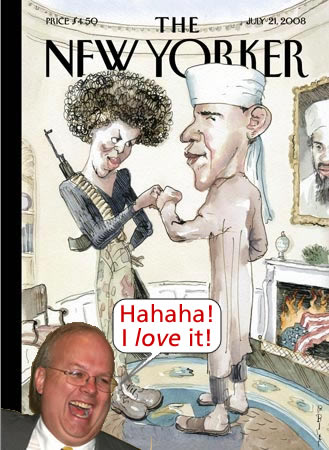
Rove likes the New Yorker Cover

There’s another insidious angle to this: to satisfy some yahoos in this country, Obama is expected to repeatedly deny he is a Muslim (or assert he is a Christian)—as if there is something inherently wrong with being a Muslim. Juan Cole writes:

It is typical of the atmosphere in America today that the New Yorker cover caricaturing the Obamas is called offensive by the Obama campaign but virtually no one is talking about how demeaning it is of American Muslims. A little detail like that. Imagine if a US candidate had been depicted as an Orthodox Jewish settler with an Uzi machine gun in the West Bank, the hue and cry that would ensue.

The Nation has a graphic response that puts the Obamas back in normal clothes and Eustace Tilley (the rich New Yorker with a monacle) flat on his ass. “Round 2” says the sign held by Michelle.
Posted in Agora | Tagged , | Leave a comment

Litvinenko

I’ve been a little slow in posting this update to l’affaire Litvinenko. Back in May the Independent ran a follow-up, tallying up 18 months later what we know and still don’t know about how Alexander Litvinenko died.

That article pointed to a piece by Edward Jay Epstein in the New York Sun from March of this year. Epstein, you will recall, almost immediately expressed doubts about the official version of the matter, bruited in the British press—doubts that I shared, along with his suspicions about who was probably behind it. He was barely audible amid the braying of the American commentariat, which echoed the UK press in pointing the finger of blame at none other than the president of Russia at the time, Vladimir Putin.

Epstein traveled to Russia to talk with prosecutors there. In the process, he was able to view the materials the British government supplied in support of its request that the Russians extradite Scotland Yard’s prime suspect, Andrei Lugovoi. Here’s the thumbnail version of the Epstein article:

  • The polonium-210 could have come from almost anywhere (not just Russia but “America, Britain, China, France, India, Israel, Pakistan, Taiwan, North Korea, or any other country whose nuclear reactors have not been inspected by the International Atomic Energy Agency”).
  • The “Putin hit job” line came from Berezovsky-funded sources; Litvinenko himself was heavily subsidized by Berezovsky.
  • The British authorities did not provide an autopsy report to the Russians. “Like Sherlock Holmes’s clue of the dog that didn’t bark,* this omission was illuminating in itself,” Epstein writes.
  • The “radiation trail” is unclear, and “in London the trail was inexplicably erratic.” Yes, it really does matter.
  • Litvinenko “initially said he believed that he had been poisoned at his lunch with [the Italian ne’er-do-well Mario] Scaramella at the Itsu restaurant. Even one week after he had been in the hospital, he gave a bedside BBC radio interview in which he still pointed to that meeting, saying Mr. Scaramella ‘gave me some papers … after several hours I felt sick with symptoms of poisoning.’ At no time did he even mention his later meeting at the Pine Bar with Mr. Lugovoi.” Let alone Putin—that accusation came later.
  • Epstein’s hypothesis: “Litvinenko came in contact with a Polonium-210 smuggling operation and was, either wittingly or unwittingly, exposed to it. … His murky operations, whatever their purpose, involved his seeking contacts in one of the most lawless areas in the former Soviet Union, the Pankisi Gorge, which had become a center for arms smuggling. He had also dealt with people accused of everything from money laundering to trafficking in nuclear components. These activities may have brought him, or his associates, in contact with a sample of Polonium-210, which then, either by accident or by design, contaminated and killed him.”

And there we leave it, for now.
__________
*See Conan Doyle’s “Silver Blaze.” I happen to be in the midst of a romp through all the Sherlock Holmes stories. At the end of the very first tale, we find a quote from a newspaper account of the case called “A Study in Scarlet”:

It is an open secret that the credit for this smart capture belongs entirely to the well-known Scotland Yard officials, Messrs. Lestrade and Gregson. The man was apprehended, it appears, in the rooms of a Mr. Sherlock Holmes, who has himself, as an amateur, shown some talent in the detective line and who, with such instructors, may hope in time to attain some degree of their skill.

Needless to say, they were, in fact, clueless. [back]

Posted in Russia | Tagged , | Leave a comment

Peddler

Since I’m one-quarter Slovenian, and have observed quite a few Slovenians up close, it doesn’t surprise me that they are capable of remarkable feats of pigheaded persistence.

You will recall how Martin Strel last year added the Amazon to the list of long rivers whose entire length he has swam.

Now we hear that Jure Robič has won the Race Across America for an unprecedented fourth time (in the solo category).

In the words of the race sponsors:

[T]he Race Across America (RAAM) [is] the world’s premiere ultra-endurance cycling event. This 3,000 mile bicycle race started from Oceanside [California] and stretches through 15 states, across the Rockies, through the heartland of America and the Appalachians, and finishes in Annapolis, Maryland. RAAM pits competitors against each other, the ever challenging and changing American landscape, and themselves.

The major difference between RAAM and other bicycle races like Le Tour de France is that RAAM is a continuous, one-stage event, meaning that the clock starts on the west coast and doesn’t stop until the racers reach the east coast. Simply put: RAAM is the toughest bicycle race on earth.

Čestitam, Jure!

Posted in Random | Tagged , | Leave a comment

Guns

When you’re caught between apoplexy and despair, your writing might get a little disjointed. You’re prone to ask too many rhetorical questions. Like this:

For hundreds of years, we have understood in this country that “keeping and bearing arms” is different from “having a loaded gun in the drawer of your nightstand.” Now we don’t. Devolution. What else could it be?

Antonin “Tony the Mouth” Scalia says Second Amendment protections extend only to “weapons in common use, like rifles and pistols.” There’s strict constructionism for you. Strictly pulled from the justice’s well-constructed colon. I guess a notion like “arms control” doesn’t fit there, let alone a bazooka.*

If the Founders (or Framers, actually) didn’t think the Second Amendment had to do with communal defense, why did they add the “militia” clause? What’s the point? Were they drunk at the time? They also used the term “bear arms,” which has a distinctly military connotation. (You don’t bear arms to go hunting—you take your rifle.) Was it a slip of the collective pen? Yet it goes perfectly with the militia clause. (Just to confuse future generations, they drunkenly threw in another couple of words, making it “keep and bear arms.” But they also said “the people,” which sounds like “We the People,” which is a collective entity. When speaking of individuals in the Constitution and Bill of Rights, didn’t they tend to say “person” or “the accused” or some such singular, noncollective noun?)

Several people in the blogosphere have said “well-regulated” = “well-equipped.” Say again? Is English their native tongue? It’s this kind of crap that makes one want to put a gun to one’s temple.

Washington’s mayor says, while it will now be legal for DC residents to have a handgun in their home “for self-defense,” it’s still illegal to carry that gun outside the home. Makes you wonder how the damn thing gets into your home. I mean, even if you buy it on the web (is that even legal? as if I know), someone has to deliver it, right? What about when you want to go out and shoot a few paper people for practice? There’s bound to be a bit of distance between your doorstep and the friendly neighborhood firing range.

Okay, enough kvetching. My solution (probably not original): let anyone have bear a handgun, but make it illegal to keep ammunition. Second Amendment protections do not extend to ammunition, now, do they? All ammo will be stored in licensed facilities, where you can shoot your gun to your heart’s content. When you leave, you will be checked—and I mean airport-security, see-through-the-clothes checked—for shells. Don’t try to leave with even one cartridge. It’s sort of like the inkjet printer scam. The printers themselves are dirt cheap—it’s the consumables that’ll kill ya. In the case of bullets, of course, this is literally true.

The Framers certainly left open the possibility that their fancy new system wouldn’t work and might even need to be overturned in accordance with something other than Marquess of Queensberry rules. In the scenario limned above, if The People decide they want to rebel, they need to make sure the ammo dump guys are on their side. Chances are good, since these working stiffs are likely to be more akin to The People than to bluebloods and plutocrats like [fill in your favorite bluebloods and plutocrats—mine may not be yours, but added together … did someone say “class warfare”?]. The simple and very strictly constructed formula is:

r = d(a/g),

where r is revolution, d is widespread discontent due to longstanding grievances, a is ammunition, and g is guns. If a or d equal zero, r = 0, no matter how large g is.**

The New York Times noted that Tony the Mouth Justice Scalia, in his dissent in the recent Guantánamo habeas corpus case, warned portentously that the decision “will almost certainly cause more Americans to be killed”; yet he seems not to notice or care that Americans will die with much greater certainty because of his gun ruling. And, if I were a betting man with no scruples about wagering on a person’s life and death, I would lay heavy odds on most of them being innocent folks—bystanders at a stickup, kids in a gun-infested home, philandering spouses, bilking business partners, and so on. Clearly, by “innocent” I mean “no physical threat to you or me or anyone,” not “pure as the driven snow.” That is to say, people like you and me, who don’t deserve one-man justice delivered from the barrel of a gun, or the boilerplate newspaper comment about being “in the wrong place at the wrong time.” Just so some people—the ones who lack any feel for the statistics that actually govern our lives—can feel secure against the boogeyman who never comes. They can sleep soundly, dreaming of how they will be able to point their Smith & Wesson Model 910S (American Pride Series™) at a burglar with one hand while calling the police with the other. Just like on TV.
__________
*Okay, “Tony the Mouth” is a cheap shot. That son-of-a-gun brings out the absolute worst in me. Apologies to all my Italian friends and family. And remember: my favorite food is spaghetti. [back]
**I don’t have a lawyer, but if I did, she would insist I point out that I am advocating neither (1) nastiness toward my social and economic betters nor (2) armed insurrection. (Not yet, anyway.***)
***Kidding.****
****Maybe. [back]

Posted in Agora | Tagged , , | Leave a comment

Ticket

Russians may be great chess players, but they don’t seem to get the hang of American politics. Commenting on press reports that Hillary Clinton is open to the idea of being Barack Obama’s running mate, a reporter for Moskovskii Komsomolets writes:

Experts predict … if Obama invites Clinton to join his team as vice president, supporters of both candidates will simply be added together. If these two former competitors join forces, Republican candidate John McCain will have practically no chance at victory.

In US politics, 2 + 2 rarely equals 4.

Former president Jimmy Carter, on the other hand, sees things a bit more clearly: picking Clinton would be a disaster.

“I think it would be the worst mistake that could be made,” said Carter. “That would just accumulate the negative aspects of both candidates.”

Carter, who formally endorsed the Illinois senator last night, cited opinion polls showing 50% of US voters with a negative view of Clinton.

In terms that might discomfort the Obama camp, he said: “If you take that 50% who just don’t want to vote for Clinton and add it to whatever element there might be who don’t think Obama is white enough or old enough or experienced enough or because he’s got a middle name that sounds Arab, you could have the worst of both worlds.”

A few weeks ago, a Slate article argued that an Obama–Clinton ticket just might work, and offered historical precedents. But I agree with Carter: Clinton’s negatives are just too high. Obama can find a VP who will bring virtually unalloyed positives to his campaign. Although some I know have pushed for Bill Richardson, it’s surprising that I haven’t heard Wesley Clark mentioned. At any rate, the Democratic Party is full of good choices for vice president. I’m content to sit back and see what Obama comes up with.

Posted in Agora, Russia | Tagged | Leave a comment

Surnames

Seen on the rump of a car last week:

O’BAMA 2008
♣ Vote Irish ♣

And today: Jeff Greenfield on the American preference for presidents with unchallenging (i.e., bland, preferably mono- or bisyllabic Anglo-Saxon) last names. Could a George W. Dukakis ever have been elected? George W. Kucinich (or Voinovich)? George W. Deukmejian? A “nation of immigrants”—yeah, so what?

Addendum 2008.10.31: “There’s No One as Irish as Barack O’Bama” (posted to YouTube in February ’08) [h/t to Thomas N.]

Posted in Agora | Tagged , , | Leave a comment